Wednesday, July 11, 2012

Freedom Theatre Artistic Director on hunger strike in Israeli prison

July 5, 2012 Samidoun
 
Press Release from The Freedom Theatre, Jenin, Occupied Palestine, July 5th, 2012

Today Nabil Al-Raee, the Artistic Director of The Freedom Theatre was accused in an Israeli military court of possessing guns, helping a wanted person (Zakaria Zubeidi) as well as three other wanted but unnamed persons. The help Nabil is accused of rendering Zakaria – who years ago was granted amnesty by the Israeli authorities – is that he has driven him in his car and given him food and cigarettes. In response to these accusations Nabil declared that he is starting a hunger strike from tomorrow. “I don’t understand why I’m here [in detention]. There is no reason for them to keep me here”. Nabil’s lawyer says: “This shows that that they are desperate, they have nothing to hold against him.”

Nabil was taken by the Israeli army on June 6th at 03:00 in the night from his house in front of his family. For two weeks he was not allowed to communicate with his lawyer or have any contact with his family. Nor were any charges made against him. Once suspicions were eventually put forward, Nabil was first suspected of keeping information that could lead to the identification of Juliano Mer Khamis’ murderer. In a later court hearing the Israeli prosecution claimed that Nabil was involved in “terror activities”. Then in a recent court hearing the military judge declared that no evidence of any illegal activity had come up during the almost one month of interrogations and that Nabil would be released. However the prosecution was given a 48 hour period to appeal and put forward this third, equally absurd accusation against Nabil.

Micaela Miranda, Nabil’s wife, attended the court hearing today: “This farce started with them accusing Nabil of being involved somehow in the murder of Juliano, then they accused him of terror activities and now it’s something else. Every court hearing we go to there’s another accusation, it’s ridiculous and it’s obvious that they are trying to find a justification for having kept Nabil incarcerated for so long.”

Smadar Ben-Natan, Nabil’s lawyer, says: “This shows that they really don’t have anything to hold against him. If these are crimes then it means that everybody in Jenin camp are guilty of them. I hope that the judge in the next court hearing will understand this and that they will release him.”

The Freedom Theatre Foundation in Sweden and The Freedom Theatre association in Jenin with its friends associations in USA, France, Italy, Scotland and Germany rebuke these accusations as pure fabrications that are part of the Israeli occupying force’s attempt to destroy The Freedom Theatre entirely.

“Maybe they thought we would break down when Juliano Mer Khamis was assassinated, but we kept on and now they are trying to suffocate us slowly but surely by harassing our employees, members and supporters with various accusations, one more absurd than the other. This systematic harassment has gone on for a year now, it’s enough!” says Jonatan Stanczak, the Managing Director of The Freedom Theatre.
Distinguished public figures such as Danny Glover, Noam Chomsky and Judith Butler along with almost 200 other people from the artistic community in the USA have called for the immediate release of Nabil and Zakaria in a statement in TimeOut magazine in New York. Artistic communities in Germany, the UK and elsewhere have made similar calls and thousands of individuals from all over the word have signed petitions and made complaints to Israeli and Palestinian representative bodies. A few weeks ago 56 members of the European Parliament signed a letter urging Catherine Ashton to take action and 19 members of the Portuguese parliament, from all political parties except the extreme right, called for Nabil’s release.

For more information, please see previous Press Release here: http://thefreedomtheatre.org/news.php?id=254

Concern mounts for the life of Akram Rikhawi on his 85th day of hunger strike

 July 5, 2012 Addameer

An independent doctor from PHR-IL visited Akram Rikhawi yesterday and an Addameer lawyer visited him today, along with Samer Al-Barq and Hassan Safadi. Samer and Hassan are still denied access to independent doctors.

Joint Press Release, Addameer Prisoner Support and Human Rights Association and Physicians for Human Rights-Israel
 
Ramallah-Jaffa, 5 July 2012—Physicians for Human Rights-Israel (PHR-IL) and Addameer Prisoner Support and Human Rights Association are gravely concerned for the life of Akram Rikhawi, who is now on his 85th day of hunger strike. An independent doctor from PHR-IL visited Akram in Ramleh prison medical center yesterday, 4 July, which was made possible only after an appeal to the Israeli District Court, where the judge eventually ordered the Israeli Prison Service (IPS) to allow the entry of the independent doctor no later than 3 July.
 
Following the visit to Akram, the PHR-IL doctor reported the alarming deterioration of Akram’s asthma, which continues to be unstable. The doctor believes Akram has been given very high doses of steroids as treatment, which can cause severe long-term and irreversible damage. The doctor reiterated recommendation for immediate examination by a lung specialist, which was not performed as recommended after the last visit by an independent doctor on 6 June.

Akram also reported that he is experiencing severe dizziness, can no longer walk and is having difficulty standing. Even more troubling, Akram has not been given any assistance in these matters, leaving him vulnerable to the danger of falling, which could result in fatal injury due to his osteoperosis. The doctor further noted that Akram is experiencing tingling and numbness in his left thigh, which could indicate peripheral nerve damage, and recommended immediate examination in a public hospital, for fear of permanent neurological damage.
 
The IPS has continued to punish Akram for his hunger strike by confiscating his books and reading materials, isolating him from other prisoners and cancelling his daily break. He is also being held in a cell with no fan or air conditioning, despite the high humidity and how badly it affects his asthma.
 
Akram pointed out to the independent doctor and to Addameer lawyer Mona Neddaf in her visit today that he was recently hospitalized at Assaf Harofeh Hospital, but was shackled at all times to the hospital bed and felt his needs were mostly ignored by the medical staff. He emphasized to Ms. Neddaf his desire to have unrestricted access to the independent doctors from PHR-IL.
 
Ms. Neddaf also visited Samer Al-Barq, who is on his 45th day of renewed hunger strike in protest against the extension of his administrative detention. Ms. Neddaf noted that he seems significantly weaker than during her last visit on 25 June. He is consuming only water with glucose.
 
Samer’s family has reported that he suffers from kidney problems and high blood pressure and has lost more than 25% of his original weight. On 21 June, PHR-IL submitted a request to allow access for independent physicians. On 25 June the IPS denied this request without providing any reasons.
 
Hassan Safadi is on his 15th day of renewed hunger strike, after previously spending 71 days on prolonged hunger strike. His last administrative detention order was due to expire on 29 June and, according to the agreement ending Palestinian prisoners’ mass hunger strike, he was supposed to be released on that date. However, his lawyer was informed on 21 June of the renewal of his administrative detention order for a further six months, in violation of the agreement.
 
According to Ms. Neddaf after her visit with him today, Hassan’s lawyer submitted a request to the military judge that he review the agreement and consider his immediate release. The judge responded that he would give a decision on this matter in two weeks. Hassan stressed that he will not break his hunger strike until he is released to his home in Nablus.
 
Hassan was transferred to Ramleh prison medical center last week and is currently being held in an isolated cell. He is drinking water with salt and taking vitamins due to a low potassium level in his blood. He has lost approximately 8 kilos in weight since the beginning of his renewed strike. PHR-IL submitted a request to allow access for an independent doctor on 26 June and have not yet received a response from the IPS.
 
In light of the deterioration of the conditions of the remaining Palestinian prisoners on hunger strike, PHR-IL and Addameer urge the international community to immediately intervene on their behalf and demand:
  • unrestricted access for independent physicians to all hunger strikers;
  • the immediate transfer of Akram Rikhawi and Samer Al-Barq to a public hospital, and the transfer of all prisoners on hunger strike for more than 40 days to public hospitals;
  • that no hunger striker be shackled while hospitalized;
  • that all hunger strikers—especially those in advanced stages of hunger strike—be allowed family visits, while they are still lucid;
  • that all information be given to families as to the medical condition of their loved ones, which is the responsibility of hospitals and medical staff in accordance with standards of medical ethics;
  • that Akram Rikhawi be granted release on humanitarian grounds;
  • that Hassan Safadi and Samer Al-Barq, along with all other administrative detainees, be immediately and unconditionally released.

PP/POW Updates and Announcements - 3 Jul 2012

From: "NYC ABC" <nycabc@riseup.net>
Date: Wed, July 4, 2012

Hey:

Here's the latest compilation of every other week updates. We've mailed
hard copies to Sundiata Acoli, Joe-Joe Bowen, David Gilbert, Marie Mason,
Eric McDavid, Daniel McGowan, Jalil Muntaqim and Sekou Odinga. Please feel
free to share this link:
http://nycabc.files.wordpress.com/2012/07/updates-3-jul-2012.pdf

NYC ABC

--
NYC ABC
Post Office Box 110034
Brooklyn, New York 11211

nycabc[at]riseup[dot]net
http://nycabc.wordpress.com
http://www.facebook.com/nycabc
http://twitter.com/nycabc
http://www.abcf.net/nyc

Free all Political Prisoners and Prisoners of War!
For the Abolition of State Repression and Domination!

Lynne Stewart: Bittersweet Week and the Future

Email for us from Lynne Stewart about her health and the Second
Circuit decision upholding her 10 year sentence

July 2 2012/ 9:30 am

The past week has confronted me with changes both bitter and sweet
and I want to share with all of you my outlook. On the "sweet" side
(because as progressive leftists, we always try to assuage the bitter
!) the best and most important news is that I have had my long
awaited surgery, more problematic than the Doctor expected, spent a
few days in hospital in Fort Worth and at Carswell prison and am in a
slow recovery back in my unit. I have been given a walker to insure
that I don't have a fall as the operation left me anemic and I
sometimes am a little dizzy and weak...BUT THE GREAT THING IS THAT I
AM CURED AND AM FUNCTIONING NORMALLY, with a rebuilt bladder and an
absence of discomfort from a distended uterus. (I know that this is
more information than many of you want -- my male supporters
particularly !!!) I feel better and stronger every day and am, of
course, determined to deal with healing naturally. I am not here to
praise the great care I received (still had my feet shackled, belly
chained and cuffed; no contact with anyone who might be worrying
about me etc. from the Bureau of Prisons; I can tell plenty of horror
stories about the care of the women in here); but I have come through
and am ready to soon resume STRUGGLE. Ralph paid me an unscheduled
visit this weekend gave me a real boost and will be more than happy
to report further on this positive health development !!!

THAT SAID, the bitter occurrence was of course, the snide and
unsubstantiated opinion of the Second Circuit (posted on my website)
denying any relief from the draconian sentence change imposed the
second time around. A blow, but not mortal. We will do an appeal to
all of the Judges of the Second Circuit sitting en banc, to
reverse. Hopefully and we always hope, those Judges will take a
different viewpoint. In reading the opinion there is a hypocritical
view expressed that the first Judge Koeltl sentence and opinion is
all wrong but the second sentence and opinion (as orchestrated by
their remand) was all right. Will the real decision maker please
stand up?? Also, the moral underpinning of their entire prosecution
is now more questionable with the newly elected President of Egypt
demanding the return of my "terrorist" client Sheik Omar Abdel
Rahman. If he is a hero of the Arab Spring than my aid was a
positive thing --yes??? Certainly not the criminal support the US
government gave to the 40 year Dictator Mubarak !!!

In any event, we also go forward after the en banc to the next
"legal" stage of the case...the certiorari petition for my entire
case to the United States Supreme Court. As should be remembered,
from that April day in 2002 when Attorney General Ashcroft rode into
NY and announced a "significant arrest and indictment", this is the
case that has the Bill of Rights affronted on almost every issue. As
my colleague and brother, Attorney Michael Smith said to me then;
there are First, Fourth, Fifth, Sixth, Eighth Amendment violation and
that's just for starters. We are going to confront the Government
and the Supremes and hopefully raise the awareness of the legal and
the community at large to the terrible infringements and danger to
all if my case is not reversed. Back Now to the fundamentals and as
Ralph says----"We've got them right where we want them"!! We fight on.

In closing I have to say that any weakness in my body should not be
mistaken for a weakness in my spirit or will. When I signed on for
this struggle back in 1962, to rescue my country and all its people
from the powers that would ruin, twist and destroy us all, it wasn't
for a week or a day but always--until we win. I welcome your support and love.

Starving for change: Hunger strike underway since June 10 in Georgia’s Jackson State Prison

July 2, 2012 Black Agenda Report

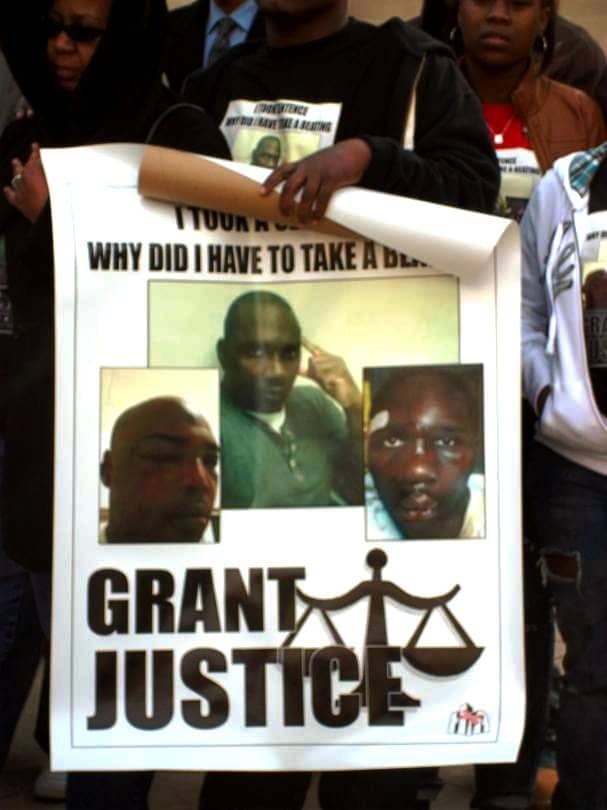
This is the photo of Miguel Jackson after he was beaten with a hammer-like weapon. Guards suspected he was a leader of the mass sit-down strike in Georgia prisons on Dec. 9, 2010.

Since June 10, according to accounts from prisoners and their families and Rev. Kenneth Glasgow of The Ordinary Peoples Society and the Prodigal Child Project, an undetermined number of prisoners at Georgia’s massive Diagnostic and Classification Prison near the city of Jackson have been on a hunger strike. Back in December 2010, Black, Brown and white inmates in several Georgia prisons staged a peaceful protest, remaining in their dorms and cells rather than go to meals or work assignments. Their reasonable demands included wages for work, speedier and more transparent status reviews, decent food, real medical care, a more sane visitation policy and the availability of educational and vocational programs behind the walls.

State corrections officials responded with temporary cutoffs of heat, water and electricity in some buildings, along with an orgy of savage assaults and beatings across multiple institutions statewide. In one instance, corrections officials apparently conspired to conceal the whereabouts and condition of one prisoner who lingered near death in a coma for most of a week while they shuffled him hundreds of miles between prisons and hospitals.

State corrections say they rounded up 37 whom they believed were the strike leaders and put them under close confinement at Jackson, the same prison where Troy Davis was executed last year. Most of these prisoners have remained there in close confinement, with severely restricted access to visits, communication and their attorneys, and without medical attention for the past 18 months.

Some of these men are the Jackson State prison hunger strikers. After two weeks, according to the families of Miguel Jackson and Preston Whiting, they are weak from hunger and subject to fainting spells. But they seem to believe they have little to lose. They are, a letter from one of them asserts, “starving for change.” There were originally 10 of them, but some may have been transferred out, and some other prisoners joined the strike. We hope to have clearer information soon.


This photo of a prisoner in Georgia lying on the cell floor in a pool of his own blood comes this week from a reliable source. More information about the circumstances has been requested and will be posted as soon as it comes in. The photo appears to have been taken by a cell phone camera, probably by a fellow prisoner. The foot and hand on the bottom and right side of the photo appear to be those of prisoners.
They are demanding access to proper hygiene, medical treatment for their numerous and severe injuries, many of which were inflicted 18 months ago, the restoration of their visiting and communications rights and access to their meager personal property. They and their attorneys insist that the Georgia Department of Corrections follow its own published procedures requiring a status review of every inmate in punitive isolation every 30 days. They further insist that such evaluations be public and transparent so as to preclude the possibility of prejudicial conduct on the party of prison officials.

One of the strikers is Miguel Jackson, who was taken in handcuffs from his cell at Smith State Prison 18 months ago, removed to a secluded area out of range of the video cameras that monitor almost every inch of most Georgia prisons, and beaten with a hammer-like object. Jackson is one of several brutalized prisoners whose injuries have been untreated since.

Despite a blizzard of demands by his attorney, prison officials have refused Jackson and other prisoners medical attention for months. And although they have not eaten in two weeks, Jackson’s wife said, at the nine-day mark when medical necessity usually demands prisoners be removed to the infirmary, prison officials simply told Jackson, “You’re going to die,” and left it at that.

Some of these men are the Jackson State prison hunger strikers. After two weeks, according to the families of Miguel Jackson and Preston Whiting, they are weak from hunger and subject to fainting spells. But they seem to believe they have little to lose. They are, a letter from one of them asserts, “starving for change.”


“Most of civilized humanity regards extended solitary confinement as a crime,” said Rev. Kenneth Glasgow. “No less an establishment figure than Illinois Sen. Dick Durbin, D-Ill., convened an extraordinary public hearing on the subject less than a week ago. We are calling on the governor to ensure proper medical treatment for the hunger strikers, to restore their visitation and other rights and to end their punitive confinement without delay.

“We hope that people around the state and around the country will call the prison, the Department of Corrections and Georgia’s governor to express their concern for the well-being of the prisoners on hunger strike, and we further hope that they will join us on Monday, July 2, for a day-long fast in solidarity with the Georgia prisoners who are only insisting upon their dignity, their humanity, their legal and human rights.”

How you can help


We at BAR and the Georgia Green Party hope that you will take the time today and tomorrow to do four things:
1. Call, email and/or fax the numbers below. Politely convey your deep concern for the welfare of the prison hunger strikers at Georgia Diagnostic Prison, especially Mr. Jackson. We believe there are about 10 of them.
2. Sign the petition to Georgia’s governor demanding an end to the torture of solitary confinement and punitive isolation in its state prisons at http://endmassincarceration.org/content/sign-petition-stop-torture-georgia-prisons.

A Georgia prisoner advocate at a Jan. 6, 2011, press conference holds a poster showing beaten prisoners. – Photo: Kristi E. Swartz, AJC.com
3. Forward this article and the link to it to all your friends, family and co-workers and ask them to do the same. Send or carry a copy to your pastor and ask him to mention the fast on Sunday, and invite him to fast that day as well.

4. Participate in the July 2 solidarity fast with Georgia’s prisoners who are standing up for their human rights across lines of race and religion. The prisoners, like the rest of us, are Black, Brown and white and of varying religious beliefs.

We demand justice for Miguel and the hunger strikers


by Delma Jackson, wife of Miguel Jackson

In January 1994, the “Georgia General Assembly passed Senate Bill 440, which gives the Superior/Adult Court exclusive jurisdiction over youth ages 13 to 17 who have been arrested for one of seven violent offenses, otherwise known as the “Seven Deadly Sins.” These crimes include murder, rape, armed robbery (with a firearm), aggravated child molestation, aggravated sodomy, aggravated sexual battery and voluntary manslaughter,” according to Wiki.answers.com.

In 1995 Miguel was convicted of armed robbery; it was his first offense, and he waived his right to a jury trial. He was convicted and sentenced by Judge William Daniel under the Georgia Seven Deadly Sins law. Judge Daniel was unfamiliar with the new law and he somehow thought that Miguel would be eligible for parole after 10 years. The Seven Deadly Sins law states that parole is not an option. Judge Daniel passed away two years after he sentenced Miguel, and we have been unable to get his sentenced corrected.


The day that shook our world


On Dec. 31, 2010, Miguel was handcuffed and beaten by correctional officers at Smith State Prison. He was taken to the hospital and treated for his injuries. That night they took Miguel back to Smith State Prison. The following morning someone took pictures of Miguel and sent them to his mother and I. We immediately drove to Smith State Prison and attempted to visit with Miguel because it was our visitation day. The prison authorities refused to allow us to visit with him despite our deep concerns for Miguel’s safety.

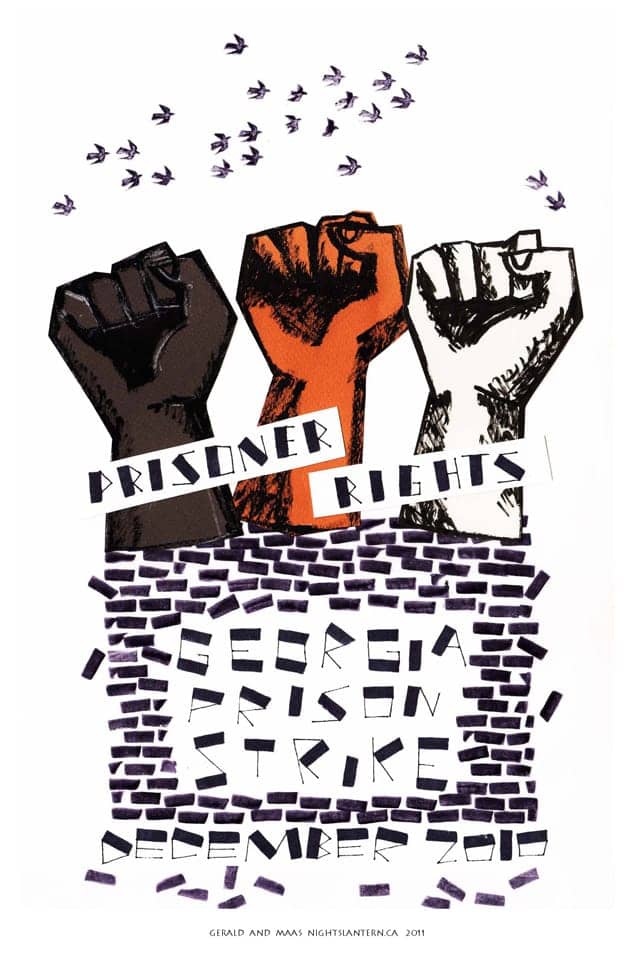
This drawing commemorates the Georgia Prison Strike of 2010, emphasizing that, like all the prison strikes since then, it was multi-racial. Race is used to divide and conquer prisoners in every prison system in the U.S., and prisoners gain power by resisting that scheme and uniting across racial lines.
They told us that Miguel was OK and nothing had happened to him. Unbeknownst to them, we had pictures that said otherwise. We asked them to just let us see him to give us peace of mind and they refused. They advised us that Warden Donnie Thompson had given them orders that if we did not leave, they would call the police and have us arrested.

Needless to say, we left and headed back to Atlanta to find help for Miguel. We contacted Channel 11 News and they got us in contact with the NAACP. We retained our attorney, Mario Williams, on Monday Jan. 3, 2011. The following day he went to visit with Miguel, and Warden Donnie Thompson refused to let him speak with his client.

Mr. Williams left and spoke with the Superior Court judge of Tattnall County. He showed the judge the pictures of Miguel, and the judge called the prison and instructed Warden Thompson to allow Mr. Williams to see his client. Mr. Williams returned to the prison and Warden Thompson would not let him see Miguel.
The head attorney for the Georgia Department of Corrections contacted Warden Thompson and instructed him to allow Mr. Williams to see Miguel and the warden still refused. Mr. Williams was informed that they would make a way for him to see his client and assured him that Miguel would be moved immediately. He also advised Mr. Williams that he would be able to visit Miguel the following day at the new institution. Miguel was transferred to GDCP in Jackson, Georgia, where he has been since Jan. 4, 2011.

Miguel suffers daily for the injuries he sustained at Smith State Prison. He has chronic migraine headaches, a broken nose, and he suffers from post-traumatic syndrome. He still has the hammer indentations in his head. He has been complaining about the headaches and has been told that he would be seeing a neurologist, which still hasn’t happened.

The medication he was recently given for his headaches is actually Neurontin. Neurontin (gabapentin) is an anti-epileptic medication, also called an anticonvulsant. It affects chemicals and nerves in the body that are involved in the cause of seizures and some types of pain. Neurontin is also used in adults to treat nerve pain caused by herpes virus or shingles (herpes zoster). Why would they give him Neurontin medicine when he is complaining of severe headaches and pain in his knees?

On Sunday, June 11, nine inmates along with Miguel declared a hunger strike, stating that they “are starving for change.”

In response to the 2010 Georgia prison strike, several solidarity actions were held around the country. Here, protesters from the Concerned Coalition to Respect Prisoners’ Rights and All of Us or None of Us rally at the Mound Road prison in Detroit on Dec. 14, 2010.
The failure to treat Miguel for the injuries he sustained at the hands of the Georgia Department of Corrections (GDOC) officers has caused extreme stress and worry for the our family. The GDOC don’t even follow their own Standard Operating Procedure (SOP), examples below:
  • Ref# II0090001 Section N-8: Inmates shall be assigned all of his or her property consistent with the length of assignment and security need of the unit. (Inmates are not given their property.)
  • Section N-5: Visitation shall be the same as the general population. (General population has open visitation; Miguel’s visits are behind a glass.)
  • Section N-10: Inmates may order items from the commissary. Items for the commissary may be withheld if determined by the Correctional Supervisor to be a threat to the security of the Administrative Segregation Unit.
  • Exercise shall be available five hours per week, one hour per day. (This is not happening: there is a shortage of guards, so inmates are not given time to exercise.)
Miguel has been held in maximum security for 18 months. He is being punished for officers beating him, and the officers are going on with their lives as if nothing happened. Where is the justice in that?


Urgent action needed!


We must demand justice for Miguel Jackson and other Georgia state prisoners who are being targeted and brutalized for exposing their inhumane conditions and standing up for their most basic human rights.

On Dec. 17, 2010, eight days after the strike, Oaklanders rallied and marched through a driving rainstorm – Jabari Shaw in the lead – in solidarity with the striking prisoners in Georgia. – Photo: Malaika Kambon
Pastor Glasgow is organizing a solidarity fasting for the hunger strike inmates, including Miguel Jackson, and against the inhumane torturous acts of Georgia prison officials. He’s hosting a rally at the Georgia State Capitol in Atlanta on Friday, June 29, 2012, from 12-2 p.m. Pastor Glasgow is calling on all to come and stand with him and other groups for Miguel Jackson and all inmates being treated wrongly throughout the country.

Please immediately make phone calls and send emails and/or letters to Department of Corrections Commissioner Brian Owens, as well as Georgia Gov. Nathan Deal (contact info listed below). Also, help spread the word by re-posting this solidarity appeal on blogs, email lists, social media etc. If you are part of an organization, send letters and make calls in the name of your group.
Please send copies of protest letters to nysocialists@hotmail.com. For more information, contact Socialist Alternative at (206) 526-7185 or info@socialistalternative.org.

We must demand justice for Miguel Jackson and other Georgia state prisoners who are being targeted and brutalized for exposing their inhumane conditions and standing up for their most basic human rights.


Register your protest and support for the 10 GDCP hunger strikers and demand justice by contacting:
  • Georgia Diagnostic and Classification Prison, Hwy 36 West, P.O. Box 3877, Jackson GA 30233, phone (770) 504-2000, fax (770) 504-2006
  • Georgia Department of Corrections Commissioner Brian Owens, at
    • (478) 992-5258 (This is the number for Owens’ administrative assistant, Peggy Chapman. Urge her to give him the message.)
    • (478) 992-5367 (This is the Office of the Ombudsman, which is the official channel for raising concerns over prisoner treatment)
  • Georgia Gov. Nathan Deal, at (404) 656-1776, by fax at (404) 657-7332, online at http://gov.georgia.gov/00/gov/contact_us/0,2657,165937316_166563415,00.html or by mail to Office of the Gov. Nathan Deal, State of Georgia, 203 State Capitol, Atlanta, GA 30334.


One Year Anniversary of Pelican Bay Hunger Strike Against Solitary Confinement

July 3, 2012 by Sal Rodriguez Solitary Watch

One year ago on July 1, 2011, approximately 6,600 inmates across California launched a hunger strike in protest of conditions at Pelican Bay State Prison.  The leaders of the strike were a group of prisoners referred to as the Pelican Bay Short Corridor Collective, a multiracial group of prisoners.

The group issued five demands:
1. End Group Punishment & Administrative Abuse
2. Abolish the Debriefing Policy, and Modify Active/Inactive Gang Status Criteria
3. Comply with the US Commission on Safety and Abuse in America’s Prisons 2006 Recommendations Regarding an End to Long-Term Solitary Confinement
4. Provide Adequate and Nutritious Food
5. Expand and Provide Constructive Programming and Privileges for Indefinite SHU Status Inmates.
The strike would last three weeks before coming to an end. Several strikers would be hospitalized. The strike brought attention to the widespread use of solitary confinement in California; currently, approximately three thousand inmates are held in one of California’s three Security Housing Units, where inmates determined to be gang members are sentenced to indefinite terms in solitary confinement. Those sentenced to the SHU for gang validation must either become an informant and leave the gang, must be inactive for six years, or they must parole from their sentence; the phrase “Parole, Snitch, or Die” captures the means of leaving the SHU.

The strike prompted the California Assembly’s Public Safety Committee to hold a hearing on the issue of long-term solitary confinement in California’s prisons. Corrections officials defended their use of the SHU, arguing that it was necessary in controlling prison gangs. Critics pointed to the mounting evidence of the detrimental effects of solitary confinement, the absence of due process in gang validation, and the fact that many inmates have been isolated for decades.

The hunger strike would not be the last. On September 26, 2011, prisoners would launch another hunger strike that would also last approximately three weeks.

At least two hunger strikers would commit suicide.

Smaller strikes would follow at Corcoran State Prison’s Administrative Segregation Unit months later.  One hunger striker, Christian Gomez, would die during the strike.

In March 2012, California Correctional officials released a new gang validation policy. The plan revised the criteria for being validated a gang member and implemented a step-down program in which inmates could hypothetically be released from the SHU in four years, instead of the average of 6.8 years. This plan would
Many of the original hunger strike leaders issued a counterproposal. Several have commented that the proposed reforms are inadequate and argue instead that placement in solitary should be based on conduct rather than real or suspected prison gang membership.

On May 31, the Center for Constitutional Rights filed a federal lawsuit on behalf of Pelican Bay SHU inmates who have been in solitary confinement for over 10 years, arguing that such long terms in solitary constitute violations of the Eighth Amendment. In addition the lawsuit challenges the gang validation system, arguing that the current system is a denial of Due Process rights.

To date, there remain over 3,000 inmates in Security Housing Units, and thousands more housed in solitary confinement in one of several Administrative Segregation Units across the state.

It remains to be seen how the new CDCR policies are implemented and how the many inmates effected by them will react.

Writings from Hunger Strikers:
Letter from a Pelican Bay Hunger Striker
Letter from a Tehachapi Hunger Striker

Profile of a Pelican Bay Hunger Striker
“Give Us in Here the Strength to See This Thing Through”: A Chronicle of the Pelican Bay Hunger Strike

Prisoners Respond to Policy Reforms
Five Prisoner Responses to the Gang Validation Reforms
Prisoner Counterproposal
Voices from Solitary: A Lose-Lose Situation

Break the Chains Blog Turns Six Years Old

June 30, 2012

Since June 2006 to present day, the Break the Chains Blog has published
over 5,400 stories on government violence and intimidation worldwide. We
gather news from a variety of sources including political prisoners and
the growing social struggle inside prisons. Seeing these stories together
as an archive shows a bigger picture of how a small, well-organized group
of people can dominate billions of people with a combination of threats
and bribes. This archive is a research tool for social movements working
towards human liberation. The aim is to break the chains of repression
with knowledge so history stops repeating itself and humanity can move
past hierarchy as a human relation.

Wherever people resist exploitative and oppressive conditions to free
themselves, government soon arrives to forcefully mange the situation.
Then the corporate or state media purposely misrepresent the facts in the
government’s favor to the people at large, often leaving them confused.
For example, news media will often call protesters violent when unprovoked
police attack people protesting. Governments of the world play this cycle
out repeatedly with aesthetic variations in their brutality. Every
government seems willing to kill, torture and cage humans to retain and
maintain power.

The Break the Chains blog autonomously publishes news from the old Break
the Chains Collective listserve. Currently we have reports coming in from
Russia, Greece, the UK, Australia, Palestine and more. We are always
looking to expand our coverage. Once people clearly see how repression
works then they can overcome it and self-emancipate.

Tuesday, July 03, 2012

Extensive police operation in Thessaloniki against anarchist spaces; at least 34 detentions so far

July 2, 2012 Occupied London

This morning (July 2nd) saw an extremely extensive police operation in the city of Thessaloniki, targeting the local anarchist scene. As of 13:00 GMT+2, the information we’ve got is the following:

Police stormed the anarchist occupation Nadir at approximately 6.30 AM, detaining people inside.
They then also stormed the anarchist residential squat Orfanotrofeio, also detaining people there.
Meanwhile, police were raiding anarchist’s houses, detaining at least 6 people in their homes.

Media report that the extended operation follows a police case file concerning events of recent months in the city (what events, it is unspecified…)

At 13:15, alterthes was reporting “34 detentions, of which 25 will be converted into arrests” – i.e. those 25 people will face charges.

More info as it comes.

After 83 Days on Hunger Strike, Detainee in Serious Condition

Monday July 02, 2012  by UFree Network 

Diabetic Palestinian prisoner Akram Rikhawi has been on a hunger strike for 83 days and is at imminent risk of dying. According to the World Medical Association, in most cases death occurs between 42nd and 72nd days of hunger strike.
strike_hunger.jpg
Rikhawi suffers from various chronic conditions: diabetes, asthma, osteoporosis, kidney problems, deterioration of his eye lenses, high cholesterol, and immune deficiency.

Due to these pre-existing conditions Rikhawi's hunger strike has been even harder on his body. He was already in fragile condition a month ago. Now he is in a coma and his condition is deteriorating fast.

Akram Rikhawi went on hunger strike on April 12 when he was not granted early release on the basis of his medical condition and social circumstances. (He has 8 biological children and 5 adoptive children.)

He has requested for early release twice: in 2010, and on 5 June 2012. Every prisoner is entitled to ask to be considered for early release when at least two thirds of their sentence has been served. In all discussions, these factors were disregarded and a file with 'secret information' was the only material considered.

Rikhawi, a Palestinian from Gaza, was arrested by Israeli occupation forces in 2004 and sentenced to 9 years’ imprisonment by a military court.

During his hunger strike Rikhawi has only seen an independent doctor once, on June 6, 2012. Physicians for Human Rights-Israel (PHR-I) has made numerous requests to gain access to Rikhawi, but Israeli authorities continually deny their requests.

The situation for independent doctors to visit patients has gotten worse since the hunger strikes began earlier this spring. Now they have to apply for permission through the courts for every single visit and the courts often deny, delay and obstruct their work. This prevents the prisoners from receiving proper medical care in line with their basic, and internationally recognized, human rights.

Following the visit on June 6, the PHR-I doctor reported that Rikhawi's weight had decreased from 68 kilos to 50 kilos, a total loss of 26.5 percent. The doctor further determined that a combination of inflammation of prior chronic illnesses and the complications of hunger strike rendered hospitalisation immediately necessary, as he was at immediate risk of death.

The Israeli Prison Service (IPS) medical centre is not a hospital, and according to the PHR-I it is not properly equipped to handle the physical deterioration and effects of long-term hunger strike.

Rikhawi has been held in the IPS medical unit in Ramleh ever since his initial arrest. On 14 June 2012 the Israeli District Court rejected a PHR-I appeal to transfer him to a civilian hospital despite his critical condition.

The decision was based on a medical opinion of the IPS that denies that his life is in danger. According to the PHR-I, 'this opinion is in complete contradiction to the one of the independent doctor, and is not referring to any medical data on which it is based. It also does not relate to the opinion of the independent doctor and the risks it cites.'

Last week Rikhawi was briefly hospitalised to a civilian hospital several times, but returned to Ramleh prison clinic. This moving back and forth a patient in such a critical condition could also amount to a medical neglect. Akram has also been shackled to his hospital bed with three limbs, even though he is in a very critical condition.

On Tuesday 19 June, an Addameer lawyer, Ms. Neddaf, noted following her visit to Ramleh prison medical clinic that Rikhawi was extremely tired, weak and weighed only 49 kilos.

Furthermore, since 16 June, he has been refusing any vitamins and fluids through an IV. (The IPS doctors' threats to force-feed and force-treat him, in addition to their determination not to recommend his medical condition as worthy of earlier release from prison, has led Rikhawi to regard them with deep distrust.)

Though he is sustaining himself on water alone, Ms. Neddaf was troubled to observe that even drinking water was very difficult for him and he was only able to consume approximately one litre per day.

Court Confirms Ten-Year Sentence for Lynne Stewart

June 29, 2012 lynnestewart.org

BY JEFF MACKLER

The U.S. Court of Appeals for the Second Circuit today confirmed the 2010 decision of Federal District Court Judge John Koeltl to change his 28-month jail sentence for radical attorney and human rights activist, Lynne Stewart, to ten years. The court’s June 28, 2012 decision was not unexpected.

Following federal prosecutors’ appeal of what was widely considered a “lenient sentence,” the Second Circuit all but ordered a compliant Koeltl to re-sentence Stewart and harshly. Koeltl did just that, forcing Stewart to appeal to the very court that originally pressured Koeltl, in what was widely considered a “career decision” to do Stewart great harm.

Stewart was convicted at an outrageous 2005 New York frame-up trial on five counts of conspiracy to aid and abet and provide material support to terrorism. Her crime? Representing the “blind Sheik,” the Egyptian cleric, Omar Abdel Rachman, who had also been convicted on trumphed-up conspiracy charges. Stewart issued a press release from her client stating his views on how Egyptian Muslim oppositionists should react to the ongoing crimes and murders of Egypt’s then President Hosni Mubarak.

Stewart was convicted of violating a vaguely-worded court-ordered SAM (Special Administrative Measure) that barred her from revealing her client’s opinions. The penalty for such violations had traditionally been a mild slap on the wrist, perhaps a warning to not repeat the “violation” and to bar attorney-client visits for a few months. Barring an unlikely Supreme Court reversal, she will now serve her ten-year sentence with perhaps a one-year or ten percent reduction for “good behavior.” She is presently incarcerated at FMC Carswell in Fort Worth, Texas.

Koeltl’s original 28-month sentence statement, in the face of federal prosecutors demanding 30 years, noted that Stewart, known for representing the poor and oppressed for three decades with little financial remuneration, was a “credit to the legal profession.” Stewart served as lead counsel for her client along with former U.S. Attorney General Ramsey Clark, who testified on her behalf during the trial. Clark himself had issued similar press releases with no punishment. Indeed, an indignant prosecutor during Stewart’s trial suggested that Clark himself be charged with conspiracy, but his superiors decided that imprisoning the nation’s former top attorney was not yet in their game plan and the suggestion was ignored.

The Second Circuit decision was based on the allegations that Stewart demonstrated insufficient deference to the original sentence. The court claimed that her statement to the media immediately following her sentence that, “I can do 28 months standing on my head,” demonstrated contempt for the legal system. I was standing next to Stewart at that moment and saw nothing other than a great expression of relief that she would not be sentenced, in effect to death, based on the 30 years that federal prosecutors sought. Stewart entered the sentencing hearing on that day, totally ignorant of whether her sentence would be the deeply punishing 30 years demanded by the federal prosecutors or perhaps something that she, 70 years old at the time, could “live with” and look forward to a normal life after having served the time. She carried nothing but a plastic bag, some medicines and a toothbrush.

The Second Circuit also too umbrage at Stewart’s courageous statement when she took the stand to make her closing remarks at her trial. Her attorney at that time, Michael Tiger, asked, referring to Stewart’s issuing the press release on her client’s behalf, “Lynne, if you had to do it all over again would you do the same thing?” With a tear in her eye, Stewart stated, “I would hope that I would have the courage to do it again” She paused and continued, “I would do it again.” Stewart also insisted that her sworn duty to represent her client had to weighed against the formalities of laws or court orders that prevented such diligent representation.

This refusal to bow to authority, to show the “required deference” to legal bullies with power, outraged her persecutors, who sought vengeance in the rigged criminal “justice” system.

Stewart’s now rejected appeal argued three essential points:

I. In relying on Lynne Stewart’s public statements to enhance the original sentence of 28 months, her First Amendment rights were abridged
II. The fourfold increase in the sentence was substantively unreasonable and failed to balance her lifetime of contribution to the community and country with the criminal act of which she was convicted.
III. The Judge’s findings of Perjury and Misuse of her position as an Attorney on which he also based the increase, were error.

“Free Lynne Stewart” must remain the rallying cry of all those who cherish civil liberties and democratic rights. Stewart, like so many others, but perhaps among the first tier, was a victim of the government-promoted malicious and murderous “war on terror” aimed at stifling all dissent and imprisoning the innocent to justify its wars against working people at home and against the oppressed and exploited across the globe.

Jeff Mackler is the West Coast Coordinator of the Lynne Stewart Defense Committee