Thursday, January 26, 2012

Report on Carlos Montes court day hearing of January 25, 20012

www.stopfbila.net

Today there was an extremely serious development in Carlos' case. LA
County Superior Court Judge Lomeli denied the motion to dismiss the 6
felony charges, setting the stage for trial later this year.
Prosecutors have stated in the press that Carlos may face about five
years in prison. The fight is on!

Today we had a good turnout of support with people who packed the
courtroom. Carlos and his attorney had presented a motion to drop the
charges on the grounds of insufficient evidence. Specifically
challenging the state's claim that Carlos has a felony conviction
from his 1969 persecution for leading a student strike demanding
Chicano/a Studies and Black Studies at ELA College. During the
student strike of Chicano and Black students, the LA County Sheriff's
Department invaded the college campus during a rally. The Sheriffs
confronted students beating and arresting some. Carlos was arrested
and charged with assaulting a Sheriff's Deputy. The legal record does
not support the DA contention that Carlos has a felony conviction.
The DA and court continue to move forward with this unjust
prosecution based on a 42 year old case. This is really about Carlos'
deep and long involvement in the antiwar, migrants' rights and
solidarity movements that challenge US empire. Carlos needs your support!

The state via the DA and Judicial system wants to put Carlos in jail
for his political activism. We need to continue to build on the
support Carlos has and get ready for a full trial, where Carlos
believes that a jury of his peers will find him not guilty, but we
have to fight!

The next court date is February 8, were Carlos and team will continue
the discovery process on the Sheriffs to get ready for trial! Please
see our web site for further details on time and location for an
emergency meeting in Los Angeles, on Saturday, February 11, 2012.

Committee to Stop FBI Repression

www.stopfbila.net
(626) 532-7164

Correction: Rare Admission of Mistake in Mumia Case

Jan 25, 2012 This Can't Be Happening

I made a mistake.

An article I wrote recently for TCBH about the Pennsylvania prison system’s latest punitive assault on now ex-death row inmate Mumia Abu-Jamal (unnecessarily continuing his solitary confinement) contained a factual misstatement.

Most journalists consider any inaccuracy an error, regardless of how small.

The Code of Ethics of the Society of Professional Journalists calls for admitting “mistakes” and correcting them promptly.

This journalist’s inaccuracy-as-error standard contrasts with court systems, where appellate courts too often dismiss mistakes made during trials by prosecutors and judges without correction by using the court-invented legalistic term: harmless error.

The Abu-Jamal case is fraught with such misconduct and mistakes that appellate courts have not only not corrected, but have allowed to fester and get worse. But you won't see the courts or the prosecutors ever admitting those things.

In my article, I inaccurately listed Pennsylvania state prison officials as being the prime movers in keeping Abu-Jamal on death row instead of transferring him into general prison population after a federal judge had voided his death sentence in a December 2001 ruling converting that sentence to a life in prison.
Pennsylvania prisoners are put in "the Hole" for their politics, for protesting prison conditions, and for racist reasons

Pennsylvania prisoners are put in "the Hole" for their politics, for protesting prison conditions, and for racist reasons

In that article I stated prison authorities kept Abu-Jamal on death row in 2001 “as a courtesy to Philadelphia’s District Attorney’s Office…”

Yes, keeping Abu-Jamal on death row arose from a courtesy…a courtesy that kept him on death row ten years after that 2001 ruling.

And yes, Philly’s DA (and others) did want Abu-Jamal to rot on death row.

But, no, Pennsylvania prison authorities did not extend that "courtesy."

That "courtesy" came from William Yohn, the federal District Court judge who voided Abu-Jamal’s death sentence after finding errors in the 1982 jury deliberations resulting in Abu-Jamal receiving the death penalty.

Yohn granted a request from Philadelphia’s then District Attorney Lynne Abraham, who wanted to keep the outspoken author/activist in solitary death row confinement during her appeal of Yohn’s ruling.

Author J. Patrick O’Connor, in his probative book “The Framing of Mumia Abu-Jamal, wrote that Abraham, “in a particularly spiteful maneuver,” requested that Yohn stay his order lifting Abu-Jamal’s death sentence and, “incredibly,” Yohn agreed.

With that "courtesy" Yohn allowed Abu-Jamal to suffer death row deprivations despite his judicial determination that Abu-Jamal had unjustly spent nearly twenty-years in solitary confinement due to that legally flawed sentence.

Abraham, in the wake of Yohn’s ruling, had blasted him.

An angry Abraham, in December 2001, said she was “completely dismayed” that Yohn had granted “any relief whatsoever.”

Abraham’s reaction ignored the fact that federal district and appellate courts in Philadelphia had cited penalty phase errors (the same failing Yohn found in Abu-Jamal’s case) in two of the four death sentences those courts voided between May and November 2001.

Maureen Faulkner, the widow of slain Officer Daniel Faulkner, had also blasted Yohn, calling him a “sick and twisted person,” despite Yohn dismissing 28 of the 29 appeal claims raised by Abu-Jamal, including all claims regarding his conviction, which if accepted could have led to a new trial for Abu-Jamal, possibly leading to his release.

While my article inaccurately assigned that "courtesy" off keeping Abu-Jamal on death row to prison authorities instead of Yohn, the article did accurately account for the wasted costs of that "courtesy."

Keeping Abu-Jamal on death row for an additional decade cost Pennsylvania taxpayers at least $100,000 because the state's prison system spends at last an extra ten thousand dollars per year over the cost of incarcerating ordinary prisoners to handle each death row inmate.

In early December 2011, prison authorities finally shifted Abu-Jamal from death row into more harshly restrictive Administrative Custody (a/k/a The Hole) hours after Philadelphia’s DA announced he would not seek reinstatement of a death sentence.

Yohn’s 2001 ruling required the DA to either hold a mini-trial in an effort to obtain a new death sentence from a new jury, or to accept a sentence of life imprisonment. The federal Third Circuit Appeals Court twice upheld Yohn’s ruling and the U.S. Supreme Court finally ended appeals of Yohn’s ruling last fall.

One of the many problems with the Abu-Jamal case is the refusal of police, prosecutors, prison authorities and judges to acknowledge mistakes or worse, misconduct -- both things that are not harmless.

Yohn, for example, made “several” mistakes in that 2001 ruling “on questions of constitutional rights central to commonly held concepts of justice,” as my TCBH colleague Dave Lindorff put it in his seminal book Killing Time: An Investigation Into the Death Row Case of Mumia Abu-Jamal.

Lindorff presented a disturbing, thorough analysis of Yohn’s flawed dismissal of Abu-Jamal’s jury selection discrimination appeal claims in his 2003 book.

The Third Circuit rejected Abu-Jamal’s jury discrimination appeal in 2008 despite the Third Circuit's having granted relief to other death row inmates he had raised identical jury discrimination claims.

In another mistake by Yohn that escaped scrutiny and correction by federal appellate judges, the respected jurist brushed-off Abu-Jamal’s claims that his attorney during the 1982 trial was legally ineffective because that lawyer was inexperienced in death penalty law, undercapitalized and lacked adequate support staff during that 1982 trial.

Yohn seized upon erroneous state court findings that attorney Anthony Jackson “had tried approximately twenty” first-degree murder cases. Pennsylvania state courts had twisted the exact testimony Jackson gave during a 1995 Post-Conviction Relief Actl hearing about his capital case experience.

During three days of testimony in July 1995, Jackson had repeatedly told Abu-Jamal’s appellate attorney Leonard Weinglass that he had tried "one or two" capital murder cases, serving as lead counsel only once.

According to transcripts from 1995, Jackson first told Abu-Jamal’s appeal attorney that he had tried one or two first-degree murder cases. On cross-examination by the prosecutor, Jackson did say he tried twenty murder cases but stressed that only “one or two” of those cases were death penalty cases…testimony the prosecutor did not challenge with contrary evidence. On re-direct from Abu-Jamal’s attorney, Jackson again said he had only handled one or two capital cases.

Jackson, also during that 1995 testimony, said he had received inadequate funding from the courts for his defense efforts, that he had no paralegals and investigators to assist him, that a Philadelphia judge rejected his request for another lawyer to assist him and at the time of Abu-Jamal’s trial he only had a part-time secretary because he had returned to private practice only months earlier.

Yohn and lower Pennsylvania state court judges rejected Jackson’s admission that he was “ineffective” during Abu-Jamal’s 1982 trial, arguing that Jackson’s defense effort was legally sufficient.

Yohn asserted that “even were I to assume that Jackson was inexperienced, undercapitalized and lacked adequate support, [Abu-Jamal did not] demonstrate that there is a reasonable probability that but for these [conditions] the result of the proceeding would have been different.”

While Pennsylvania prison officials kept Abu-Jamal in solitary confinement for ten unnecessary years on Judge Yohn’s orders, his current continued solitary confinement is solely the responsibility of those prison officials.

As I reported in my article, the draconian Administrative Custody confinement rammed on Abu-Jamal by prison authorities evidences violations of the prison system’s own written regulations, because that placement does not meet any of the 11 specific circumstances listed in Pennsylvania Department of Corrections regulations used to justify administrative custody placement.

The “current rationales offered by prison officials for [Abu-Jamal’s] placement in solitary confinement do not withstand scrutiny, which lends further support to the inference that he is continuing to be targeted,” said Bret Grote, spokesman for the Pennsylvania Human Rights Coalition, during a recent interview.

Typical of Abu-Jamal’s selflessness, he directs his supporters to fight not just against his unjust confinement but also to assist the scores of other people the state's Department of Corrections unjustly holds in solitary confinement on a daily basis, according to data from HRC, a prison-monitoring organization.

Grote said prison authorities improperly use Administrative Custody to penalize inmates for their political activism, for complaining about conditions, for their roles as jailhouse lawyers and often simply for racist reasons.

How George Wright Became a "Convicted Murderer" Without having Committed the Crime

George Pumphrey, Berlin, Germany
October 23, 2011

When news broke that, at the request of the US government, Portugal had
arrested George Wright (Jose Luis Jorge dos Santos), a Portuguese citizen,
for consideration of his extradition to the United States for having
escaped prison, there was an air of the spectacular in the news articles.
The accent in many articles was on the arrest of a "convicted murderer,"
who had been a fugitive for 40 years.

George Wright had escaped from the Bayside State Prison in Leesburg, N.J.,
in 1970, where he had served more than seven years of a 15 – 30 year prison
sentence for murder.

It was also reported – almost in passing – that Wright and four other
Afro-Americans had hijacked a Delta Airlines jet from the US to Algeria in
1972 with a ransom of $1 million destined to the foreign section of the
Black Panther Party located in Algeria.

But the demand for his extradition is allegedly merely to return Wright to
prison to "finish his time."

Back to the Source

Some of the earlier articles had referred to Wright being a "convicted
murderer." Some European journals understandably believe this to mean that
George Wright had taken someone's life – "understandable," that is, when
one considers the source of this information.

FBI Special Agent, Bryan L. Travers, announcing Wrights arrest, wrote in
his press release (September 27, 2011) that

"On November 23, 1962, George Wright and three associates were involved in
the commission of multiple armed robberies. During the second of these
robberies, Wright and an associate shot and killed Walter Patterson, a
World War II veteran and Bronze Star recipient, during the robbery of the
Collingswood Esso gas station in Wall, New Jersey."[1] <#_ftn1>

The FBI special agent then explains:

Wright was arrested two days later and was indicted on state charges along
with his associates on December 13, 1962. On February 15, 1963, Wright
entered a plea of “no defense” to the charge of murder. Wright was
subsequently sentenced to 15 to 30 years’ incarceration.[2] <#_ftn2>

For European journalists, unfamiliar with the US penal system, a
translation of the background to these allegations may prove useful.

Is George Wright a Murderer?

Special Agent Travers writes that "Wright AND an associate shot and killed
Walter Patterson," while press reports from New Jersey – where Special
Agent Travers is stationed – and elsewhere tell a different story about the
incident:

"One of [the robbers], Walter McGhee, had a revolver, according to police
records. McGhee fired two shots at Patterson and ran off with $70. (...)
McGhee was sentenced to life in prison. Wright, as one of the holdup men,
was also charged with murder. He changed his plea from innocent to no
defense to evade a jury trial that could have resulted in the death penalty
if he were found guilty, according to news accounts. Wright, at age 19, was
sentenced to 15 to 30 years in prison, where he served time until his
escape in 1970."[3] <#_ftn3>

And another journalist adds more details:

Wright, armed with a sawed-off 22- caliber rifle, and McGhee, armed with a
32-caliber pistol, were both wearing women’s pantyhose over their faces
when they assaulted Patterson and fired at least one shot during the
robbery. Patterson was shot once in the abdomen before the four got away
with $70 in cash. Police later determined it was a shot from McGhee’s
pistol that led to Patterson’s death.[4] <#_ftn4>

It must have been clear – even to the FBI – that though Wright had
participated in the holdup and that though Wright had been armed, it was
not Wright, but McGhee, who was the murderer. The FBI certainly had access
to the same police records as the journalists quoted above. Nevertheless,
the FBI deliberately falsified its version of events to make George Wright
appear dangerous.

"No Defense"

There is a second aspect that may be particularly alien to Europeans about
the US system. George Wright was "convicted" of a murder that police,
prosecutor and judge all knew he was innocent of. Whereas the FBI press
release merely states "Wright entered a plea of 'no defense' to the charge
of murder," the journalists quoted above say why.

McGhee, the actual killer, was sentenced to life in prison. Nevertheless,
Wright, charged with the murder, everyone knew he had not committed, was
forced to change his plea from "innocent" to "no defense," thereby waiving
his right to a trial by jury. It was clear that if he was found guilty in
that trial, he would have received the death penalty for a crime everyone
knew him to be innocent of.

(September 21, 2011, despite pleas for clemency from around the world,
including the European Parliament, the Council of Europe and the Pope, the
state of Georgia executed Troy Anthony Davis for a murder it was evident he
had not committed. Seven of the nine witnesses against him retracted and
recanted their testimonies before the court, declaring in written
statements that they had been pressured by police and prosecution to lie in
court accusing Davis of murder. One of the 2 witnesses who has not recanted
is believed to be the actual murderer. The US Supreme Court refused to
allow the new evidence of Davis' innocence to be admitted, which would have
resulted not only in the liberation of Davis but in a new trial. This could
have also been the fate of George Wright.)

Where is the justice?

Under US law, if a more grave crime occurs – for example murder – in the
course of the commission of a lesser crime – in this case robbery – the
participants committing the lesser crime can also be charged with the
graver crime, even though it is clear that, another had actually committed
it.

Following his arrest, George Wright, having no means to hire his own
lawyer, had to therefore rely on the services of a court appointed lawyer.
These are usually inexperienced, underpaid by the court and disinterested
in cases that will do little to further their careers.

The prosecutor, who then put Wright under pressure to obtain another rapid
conviction for a serious crime, additionally charged Wright with this
murder. Wright insisted on his innocence, which meant he had a right to a
jury trial. However, jury trials cost the state money and the prosecution
would be forced to prepare his case. The court appointed defense lawyer
would also lose time on a non-paying client, time (s)he would rather spend
on a high-profile or, at least, a better paying case. So not being
interested in going to trial, the court appointed lawyer would advise
his/her client to take a "plea bargain", meaning one of the versions of not
contesting the charges, so that a guilty verdict can be pronounced by the
judge, without having to go through the normal trial procedure. Wright
pleaded that he was making "no defense" against the charges against him.

Allen N. Cowling, a private investigator specializing in cases of persons
falsely charged with crimes, explains, that "although a plea [bargain] has
many names; nolo contendere, (no contest) or an Alford, (no admission of
guilt), regardless of what it is called, it is still an admission of guilt
by an accused to an offense that they may not have committed."[5] <#_ftn5>

A "plea bargain" is an official extortion of a "guilty" plea from a
defendant, regardless of his innocence, in exchange for a promised – but
not always held – specific sentence.

The case of George Wright is a good example of how this works. Wright was
probably threatened that if he insisted on pleading innocent – meaning that
a jury would have to determine his guilt for murder – then he would have
the entire system against him. Not only the prosecution and judge – for
forcing them to take the "long road" to a conviction – but even his
"defense" lawyer would be against him. Wright's insistence on his right to
justice would have cost his defense lawyer precious time and therefore
money with a non-paying client. It is the latter that is most important
because (s)he is in a position to take revenge and sabotage his chances to
be objectively heard by the jury. Therefore, it would have been almost
certain that he would be convicted of a crime he had not committed.

Paul Craig Roberts,[6] <#_ftn6> explains:

"In the US the wrongful conviction rate is extremely high. One reason is
that hardly any of the convicted have had a jury trial. No peers have heard
the evidence against them and found them guilty. In the US criminal justice
(sic) system, more than 95% of all felony cases are settled with a plea
bargain."

And warns:

"Before jumping to the conclusion that an innocent person would not admit
guilt, be aware of how the process works. Any defendant who stands trial
faces more severe penalties, if found guilty, than if he agrees to a plea
bargain. Prosecutors don’t like trials because they are time consuming and
a lot of work. To discourage trials, prosecutors offer defendants reduced
charges and lighter sentences than would result from a jury conviction. In
the event a defendant insists upon his innocence, prosecutors pile on
charges until the defendant’s lawyer and family convince the defendant that
a jury is likely to give the prosecutor a conviction on at least one of the
many charges and that the penalty will be greater than a negotiated plea."
[7] <#_ftn7>

In principle, more than 95% of the inmates in US prisons are innocent,
simply because their guilt has not been proven – beyond a reasonable doubt
– in a trial. A plea of guilty – regardless of guilt or innocence – had
been extorted from them.

The theory behind plea-bargaining is "the confession of the defendant is
considered solving the conflict and rendering the judicial procedure
(particularly the analysis of the evidence) superfluous. This is why as
soon as there is a confession, the judge pronounces the
sentence'."[8]<#_ftn8>

"There is one snag in the whole plea-bargaining deal: once you plead
guilty, you cannot appeal your case or change your plea to not guilty. This
is another way that the American judicial system accounts for its high
percentage of Blacks in prison."[9] <#_ftn9>

Plea bargaining has robbed the US criminal justice system of its middle
name. With plea bargaining, the question of guilt and innocence – the
prerequisite for justice – play no longer a role. Through the plea
bargaining technique, the government mass-produces convictions, most of
which are Black, Hispanic and poor, sending them to prison, without ever
having had the benefit of a trial, "because it is obvious that they are
guilty. They pled guilty, didn't they?" is the reasoning usually given.

On the other hand, official propaganda, as the FBI shows above, can conjure
up a "murderer" by constantly pointing to his "conviction."

This is how George Wright became the "convicted murderer" without having
committed the crime.

------------------------------

[1] <#_ftnref1> Travers, Bryan L., International Fugitive Captured After
More Than 40 Years, FBI Newark September 27, 2011
http://www.fbi.gov/newark/press-releases/2011/international-fugitive-captured-after-more-than-40-years

[2] <#_ftnref2> ibid

[3] <#_ftnref3> Grant, Jason, "A fugitive's quiet life in Portugal:
Seaside village, friendly neighbors," The Star-Ledger, September 29, 2011,
http://www.nj.com/news/index.ssf/2011/09/a_fugitives_quiet_life_in_port.html(See
also: Ferreira, Leonardo, Após 40 anos, fugitivo norte-americano de
New Jersey é preso em Portugal, Brazilian Voice, 06/10/2011,
http://www.brazilianvoice.com/bv_noticias/bv_comunidade/41731-Aps-anos-fugitivo-norte-americano-New-Jersey-preso-Portugal.html
)

[4] <#_ftnref4> Webster, Charles, "A promise made, a promise kept" Asbury
Park Press, Oct. 1, 2011,
http://www.app.com/article/20110930/NJNEWS/309300132/Fugitive-s-arrest-brings-relief-to-the-family-of-WWII-veteran-killed-in-Wall

[5] <#_ftnref5> Cowling, Allen N., "Falsely Accused and Plea Bargains,"
http://www.allencowling.com/plea.htm

[6] <#_ftnref6> Paul Craig Roberts was Assistant Secretary of the
Treasury in the Reagan administration, Associate Editor of the Wall Street
Journal editorial page and Contributing Editor of National Review.

[7] <#_ftnref7> Roberts, Paul Craig, "America’s Injustice System Is
Criminal," December 12, 2006,
http://www.lewrockwell.com/roberts/roberts187.html

[8] <#_ftnref8> Nikiforov, Boris, "Etat Actuel de la Justice aux Etats
Unis," ed. Revue Trimestrielle de la section des Sciences Sociales de
l'Academie des Sciences de l'URSS, Nr. 4, (34) 1978, pg. 221

[9] <#_ftnref9> Brown, George, Nous Noirs Americains, Evadés du Ghetto,
Seuil, Paris, pg. 217 – 218

Socialist International supports self-determination of Puerto Rico and the release of Oscar López Rivera

Wednesday, January 25, 2012 claridadpuertorico.com

San Juan, Jan. 25 (INS).- The World Council of
the Socialist International, which just met in
Costa Rica, adopted a resolution supporting the
self-determination of Puerto Rico and the release
of political prisoner Oscar López Rivera,
according to today's report from the Puerto Rican Independence Party (PIP).

PIP spokesperson, Calixto Rivera Negrón,
explained that the resolution of the Socialist
International (SI) endorses the current call of
the United Nations Special Committee on
Decolonization that the General Assembly examine
the colonial case of Puerto Rico and the demand
for the release of the Puerto Rican patriots in
United States prisons, in particular López Rivera
who this year will have served 31 years behind bars.

The SI, the oldest and largest organization of
political parties in the world, also endorsed
efforts led by the PIP leadership to grant the
Puerto Rican independence movement observer
status in the recently created Community of
States of Latin America and the Caribbean (CELAC, by its Spanish initials).

Leaders of social democratic and socialist
parties from every continent attended the meeting in Costa Rica.

The PIP was represented by a delegation comprised
of its president, Rubén Berríos Martínez; former
senator and executive president Fernando Martín;
the candidate for governor of Puerto Rico, Juan
Dalmau, and the candidate for resident
commissioner in Washington, Juan Manuel Mercado.

Former senator Berríos Martínez is the honorary
president of the Socialist International.


Internacional Socialista favorece autodeterminación de Puerto Rico y excarcelación Oscar López Rivera

Por InterNews Service
Publicado: miércoles, 25 de enero de 2012 claridadpuertorico.com

San Juan, 25 ene (INS).- El Consejo Mundial de la
Internacional Socialista, que acaba de sesionar
en Costa Rica, emitió una resolución en apoyo a
la autodeterminación de Puerto Rico y la
excarcelación del prisionero político Oscar López
Rivera, informó hoy el Partido Independentista Puertorriqueño (PIP).

El portavoz del PIP, Calixto Rivera Negrón,
explicó que la resolución de la Internacional
Socialista (IS) respalda el llamamiento vigente
del Comité Especial sobre Descolonización de
Naciones Unidas para que la Asamblea General
examine el caso colonial de Puerto Rico y el
reclamo por la liberación de los patriotas
puertorriqueños en cárceles de los Estados
Unidos, en particular López Rivera, quien cumplirá 31 años de presidio.

La IS, la organización más antigua y grande de
partidos políticos en el mundo, respaldó además
las gestiones que encamina el liderazgo del PIP
para que se otorgue el rango de observador al
independentismo puertorriqueño en la Comunidad de
Estados de América Latina y el Caribe (CELAC), de reciente creación.

Al cónclave realizado en Costa Rica asistieron
dirigentes de partidos socialdemócratas y socialistas de todos los continentes.

El PIP estuvo representado por una delegación
integrada por su presidente, Rubén Berríos
Martínez; el exsenador Fernando Martín,
presidente ejecutivo; el candidato a la
gobernación de Puerto Rico, Juan Dalmau, y el
aspirante a delegado en Washington, Juan Manuel Mercado.

El exsenador Berríos Martínez es presidente de
honor de la Internacional Socialista.

New Zealand authorities shut down 'Occupy' camps

Associated Press – Jan. 22, 2012

AUCKLAND, New Zealand (AP) — Authorities have effectively shut down the
Occupy movement in New Zealand's largest city after more than 100 days of
protest.

Auckland Council officers and police Monday confiscated cars, tents and
camping gear from more than 50 protesters at four sites in Auckland. The
raid came after a local court ruled authorities could remove property from
people who were illegally camping.

Police arrested three people in Aotea Square during the raids.

Occupy encampments remain in other New Zealand cities. Protesters in this
country joined the movement that began last September in New York as a
protest against social and financial inequality.

Auckland Council spokesman Glyn Walters said protesters can return to the
sites but are no longer allowed to camp there.

Wednesday, January 25, 2012

Billy Silvia and Marco on hunger strike

ELP Information Bulletin (25th January 2012) Dear friends ELP has just received the
following e-mail.

> Switzerland – Marco, Silvia and Billy on hunger strike against the WEF

This is a flyer that has been distributed during the demo against the World Economic Forum in Bern (Switzerland) on the 21st of January 2012. We are translating the communiques of Marco, Silvia and Billy about the strike, they will be available soon.

“The three green anarchist prisoners held in the swiss jails decided to join the week of mobilization against the World Economic Forum, which will be held in Switzerland during these days. Marco and Silvia went on hunger strike for 10 days, since 20th to 30th of january 2012. Billy is abstaining from prison food and refusing to work (working is compulsory in swiss jails), against the WEF but also as a response to their prison conditions, more precisely for the liberation of Marco Camenisch in may 2012 and against the presence of divisory glass in the visits of friends.

Marco Camenisch was incarcerated in Switzerland in 1991, he's always been active in green anarchist struggles; Silvia and Billy were arrested, along with Costa, in april 2010 in Zurich for having tried to attack with explosives the newly built nanotechnology research center of
IBM.

We're not surprised by the fact that this year in the schedule of WEF they will also deal with nanotechnologies, because, as with all the technological systems and even more the new technologies (nanotechnologies, biotechnologies and cybernetics), they are not neutral but subjected to the ones who manage economics, and a further tool in the hands of those who hold power.

While the state and corporations bosses meet with each other to impose the new world economic developments, in the labs experts and researchers study to create new means with which to increase social control, strengthen the soldiers, try to make our lives even more artificial and automized, till the point of manipulating the living. Manipulations that provoke devastating and irreversible effects in the earth equilibriums and on human and non human animals.

We will always fight against those who are turning the earth into a land of plastic and concrete, commodities and technologies, industries and offices: a world devoid of life. Against the State and capital which, with their dominating and exploitative logics want human beings to be slaves, the animals to be good, and the planet to be an infinite source of things to sack. The WEF event cannot but increase our anger and desire to keep on struggling, in and outside jails. Solidarity with the prisoners on hunger strike!

Solidarity to Marco, Silvia, Billy and Costa.”

++++++ Earth Liberation Prisoners Support Network
BM Box 2407LondonWC1N 3XXEngland
Find us on Facebook by searching for "Earth Liberation Prisoners"

The Gray Box: An investigative look at solitary confinement

Dart Society Spring 2012

A few weeks ago, on the fifteenth anniversary of his first day in prison, Osiel Rodriguez set about cleaning the 87 square feet he inhabits at ADX, a federal mass isolation facility in Colorado.

“I got it in my head to destroy all my photographs,” he writes in a letter to me. “I spent some five hours ripping each one to pieces. No one was safe. I did not save one of my mother, father, sisters. Who are those people anyway?”

Such is the logic of the gray box, of sitting year after year in solitude.

Whether Rodriguez had psychological problems when he robbed a bank, burglarized a pawn shop and stole some guns at age 22, or whether mental illness set in during the eight years he has spent in seclusion since trying to walk out of a federal penitentiary in Florida – it’s academic. What’s true now is that he’s sick, literally, of being alone, as are scores of other prisoners in extreme isolation.

Among the misperceptions about solitary confinement is that it’s used only on the most violent inmates, and only for a few weeks or months. In fact, an estimated 80,000 Americans — many with no record of violence either inside or outside prison — are living in seclusion. They stay there for years, even decades. What this means, generally, is 23 hours a day in a cell the size of two queen-sized mattresses, with a single hour in an exercise cage, also alone. Some prisoners aren’t allowed visits or phone calls. Some have no TV or radio. Some never lay eyes on each other. And some go years without fresh air or sunlight.

“One time I kept a single green leaf alive for a few weeks. I had grasshopper for a pet. I made a guitar out of milk cartons, and it played quite well. I have done a thousand and one things to replicate ordinary life, but these too are now gone.”

Solitary is a place where the slightest details can mean the world. Things like whether you can see a patch of grass or only sky outside your window – if you’re lucky enough to have a window. Or whether the guy who occupies cells before you in rotation has a habit of smearing feces on the wall. Are the lights on 24/7? Is there a clock or calendar to mark time? If you scream, could anyone hear you?

In the warp of time and space where Rodriguez lives, the system not only has stripped him of any real human contact, but also made it unbearable to be reminded of a reality that has become all too unreal. It’s ripping him apart.

“Looking at photos of the free world caused me so much pain that I just couldn’t do it any more,” writes Rodriguez, 36. “Time and these conditions are breaking me down.”

This is what our prisons are doing to people in the name of safety. This is how deeply we’re burying them.

* * *

I got my first letter from solitary in 2008 while working as a newspaper columnist in Colorado. Mark Jordan — then at ADX on convictions for bank robbery and a prison murder – wrote asking me to cover a trial in which he’d be arguing for access to reading materials that seemed a reasonable way to cope inside a concrete box. The Federal Bureau of Prisons had banned, for instance, D.H. Lawrence’s Sons and Lovers and Anaïs Nin’s books, which Jordan had already ordered. Officers in the mailroom wouldn’t pass along his issues of The New Yorker, either, because some of the cartoons depict nude figures.

Intrigued, I went to hear Jordan represent himself in federal court by a live video feed from prison. Though he was shackled as he made his case, his arguments were as skilled as those of the most seasoned trial attorneys I had seen. He lost.

Solitary confinement slipped from my mind after I covered Jordan’s case and moved on to my next deadline. But the subject became a preoccupation months later while I was hospitalized for septic pneumonia, with an “ISOLATION” sign outside my door. Partly it was the stale air in my hospital room and the view of a brick wall out my window. Partly it was the anxiety of losing my autonomy and voice. I’d lie there pressing a buzzer to get a glass of water or to have my tubes unhooked so I could get out of bed, and nobody would answer. I’d buzz and buzz again, complaining bitterly once nurses finally showed up. I’d see them roll their eyes and hear them dissing me in the hallway. Being sick wasn’t as bad as being stuck. I remember thinking about Jordan and wondering how people who were imprisoned in solitary were able to survive it. It occurred to me then that isolation – the non-medical, punitive, indefinite kind – could crack you in about a week. Powerlessness is its own centrifugal force.

* * *

Plenty of corrections officers might tell you that offenders doing time in solitary don’t deserve the roofs over their heads or the meals shoved through their food slots. To be sure, many of these prisoners have done heinous, unforgivable things for which we lock them up tightly. Just how tightly is no small question. Yet, as a matter of public policy, the question hardly comes up. Compared to how much we as a nation have debated capital punishment, a sentence served by a small fraction of the incarcerated, we barely discuss how severely we’re willing to punish nearly everyone else.

“When the door is locked against the prisoner, we do not think about what is behind it,” Supreme Court Associate Justice Anthony Kennedy once said.

Solitary confinement started in the U.S. as a morally progressive social experiment in the 1820s by Quakers, who wanted lawmakers to replace mutilations, amputations and the death penalty with rehabilitation. The hope was that long periods of introspection would help criminals repent.

After touring a Pennsylvania prison in the 1840s, Charles Dickens described prolonged isolation as a “slow and daily tampering with the mysteries of the brain immeasurably worse than any torture of the body.” He also wrote, “There is a depth of terrible endurance in it which none but the sufferers themselves can fathom.”

Some of his contemporaries shared that view. “It devours the victims incessantly and unmercifully,” Alexis de Tocqueville reported from a prison in New York in the 1820s. “It does not reform, it kills.”

Most prisons suspended the practice in the mid- to late-1800s once it became clear the theory didn’t work. The U.S. Supreme Court punctuated that point in 1890 when it freed a Colorado man who had been sentenced to death for killing his wife, recognizing the psychological harm isolation had caused him.

“This matter of solitary confinement is not … a mere unimportant regulation as to the safe-keeping of the prisoner,” the court ruled in the case of James Medley. “A considerable number of the prisoners fell, after even a short confinement, into a semi-fatuous condition, from which it was next to impossible to arouse them, while those who stood the ordeal better were not generally reformed, and in most cases did not recover sufficient mental activity to be of any subsequent service to the community.”

“To be,” writes sociologist Joan Martel, “one has to be somewhere.”

Solitary confinement was largely unused for about a century until October 1983 when, in separate incidents, inmates killed two guards in one day at the U.S. Penitentiary in Marion, Ill., which had replaced Alcatraz as home to the most dangerous federal convicts. The prison went into lockdown for the next 23 years, setting the model for dozens of state and federal supermaxes – prisons designed specifically for mass isolation — that since have been built in the name of officer safety. “Never again,” promised Reagan-era shock doctrinarians who set out at great cost to crack down on prison violence.

“Whole prisons have been built, people have gotten funding for supermax facilities based on the act of a single (inmate),” says Michael Randle, former director of the Illinois Department of Corrections.

Administered by corrections officials, not judges, solitary confinement is a punishment beyond incarceration, removing prisoners not only from the rest of society, but also from each other and staff. It’s now practiced routinely in federal penitentiaries, state prisons and local jails under a number of bureaucratic labels: “lockdown,” “protective custody,” “strip cells,” “control units,” “security housing units,” “special management units” and “administrative segregation.” Federal justice officials say the different classifications prevent them from keeping track of how many people are being isolated. What is acknowledged even in official records is that the vast majority are men and that rates of pre-existing mental illness exceed the higher-than-average levels in general prison populations.

Prisoners who have assaulted staff often get sent straight to solitary. Those who have killed other inmates or escaped from prison — or attempted to — also take priority. Corrections officials eager to please officers’ unions and weary of public criticism tend to place difficult prisoners in solitary as an easy default.

“These become career decisions that administrators have to struggle with, knowing if a person does kill again, that you basically will get massacred in the media, massacred by the opposition, massacred by your governor’s party,” Randle says. “These are determinations that can make or break your career.”

Meantime, an analysis of prison budgets by the Urban Institute shows that taxpayers are shelling out about $75,000 a year to house a single prisoner in solitary confinement – more than twice as much as spent housing prisoners in general population. Staffing is more expensive because two or more officers usually are required to escort prisoners any time they leave their cells, and because the cooking and cleaning work, which in other prisons would be performed by inmates, must be done by paid staff. As a rule, prisoners in isolation aren’t allowed to work.

For reasons of prison safety, short periods of confinement may make sense for the most violent inmates. Yet the so-called “worst of the worst” are, by definition, the exception rather than the rule. States vastly overestimated the need for supermax space to contain high-risk offenders, and have filled it with relatively low-risk prisoners, many of whom pose no apparent risk or have no record of violence. Anyone even loosely labeled to have ties with terrorists gets put into isolation as a matter of course. Juveniles are secluded for what is officially deemed to be their own protection. Mentally ill prisoners who are prone to rage or agitation are isolated for convenience. And, all too often, having a gang affiliation, writing grievances or cussing out a guard can land you in solitary for the long haul. Bad behavior – or merely a corrections officer’s allegation of it – can add years to your time in isolation. Some prisoners have spent a decade or two asking why they’re still there, without getting an official answer.

“These are extraordinary, I believe often needless and indefensible, risks to take with the human psyche and spirit,” writes Craig Haney, a psychology professor at the University of California at Santa Cruz.

Anthony Gay had a low-level assault charge in Illinois for punching another kid, stealing a dollar from him and swiping his hat. A parole violation on his seven-year suspended sentence ultimately landed him in a state supermax where he has cut himself hundreds of times with shards of glass and metal, and eats his own flesh. He has racked up a 97-year sentence for throwing urine and feces out his food slot – behavior that’s fairly typical for severely mentally ill prisoners in solitary.

Gay passes his time at the Tamms Correctional Center writing anyone who will receive his letters.

“I’ve been trapped for approximately nine years. The trap, like a fly on sticky paper, aggravates and agitates me,” he writes. “America, can you hear me? I love you America, but if you love me, please speak out and stand up against solitary confinement.”

* * *

In months of trading letters with prisoners, and in a few dozen interviews with men who’ve gotten out, I hear the same descriptions of solitary: that it’s starkly sterile, unremittingly monotonous and numbingly idle.

“I’ve been waiting like 20-something years to say all this.”

“Ninety percent of the time you hear nothing but the sound of air from the ventilation. The silence can drive you crazy. Makes you feel as if the world has ended but you somehow survived and are tripped,” Jeremy Pinson writes from ADX, the crown jewel of the federal system once described by its warden as a “clean version of hell.”

“The world outside is like another planet,” writes Jack Powers, also from ADX. “I feel like I am trapped within a disease.”

Prisoners pace their cells like caged felines at a zoo.

“I walked and walked and walked some more,” says Darrell Cannon, who did nine years in solitary in Illinois. “I’d walk in circles – always to the left, for some reason – for six, maybe seven hours a day.”

Almost everyone in isolation spends at least some time counting. They count the steps they take, the cinder blocks on the walls, the tiles on the ceiling, their sneezes and coughs, and how many times the furnace kicks in or the plumbing sloshes.

“If I remember correctly, there are 412 holes in (the cell door). I would count them daily,” Joe Sorrentino, now serving time in a general population prison, recalls of his cell at Tamms. “At the back of the cell, close to the ceiling there’s a window approx. 30 inches long and 10 inches high with a square bar going through the middle … My window faced the tunnel, so my view for my first seven years there were of a blue wall. For years, I wondered what other guys could see out their windows.”

Some prisoners pass their time praying, meditating or talking to themselves. Some read voraciously, though often they’re limited to only a few books a month. Some take whatever enrichment classes are broadcast over their TVs. The Bureau of Prisons has offered courses on Hitler, Sparta, Animals of the World, Legends of the Silver Screen and Robert E. Lee and his High Command.

Out of limited supplies, prisoners create art. They lodge bits of sponges into ballpoint cartridges to make paintbrushes. For paint, they mix water with Nescafe grinds or dye from candy they can buy from the commissary. M&Ms – plain, not peanut – work best. For deep reds, they fold red dye in with ground powder from vitamins. Navy blue takes a three-step process mixing royal blue candy coating with blue and black ink from pens. The color purple is best achieved from Skittles.

Prisoners strike up relationships with the critters that crawl in through their air vents. One man used his own hairs to try to repair a moth’s injured wing in hopes of facilitating its escape. Mohammed Saleh — convicted of having co-conspired in the 1993 World Trade Center bombing — lost his daily hour of outdoor recreation for three months at ADX because he saved bread crumbs to feed blackbirds in his exercise pen.

Defiance can kill time in solitary. Some prisoners kick the walls or bang their cups against their doors. Some flood their cells by clogging their toilets with toilet paper, or break light bulbs and set their mattresses on fire. Some write up their grievances; some sue over them; and some sue some more on behalf of guys on their units. Those feeling especially resistant stop eating or drinking. Brian Nelson starved himself regularly at Tamms, where he spent 12 years in seclusion. He once refused food and water for 40 days, he says, to try to prod the prison to treat a guy on his unit for cancer.

“(Fasts) become addicting … You feel clean, but it’s also your body eating your body,” says Nelson. “My last hunger strike, I was on a gurney and there was no vital signs, and I went into shock.”

A hunger strike by 5,000 prisoners last fall shed light on solitary confinement conditions at California’s Pelican Bay State Prison. The strike ended when the state agreed to consider letting prisoners make phone calls and buy calendars. Months later, no substantive changes have been made on those modest demands. There have been reports that strike leaders have faced disciplinary action and that three strikers have committed suicide.

* * *

Many of us flirt with isolation. We tune out in all sorts of ways – cranking up our headphones or holing up in little rooms to write. From “Walden” to “Into the Wild,” generations have idealized solitude, wondering how long we could last on our own. Fox Reality Channel’s show “Solitary” kept contestants in voluntary round-the-clock confinement competing for $50,000 in prize money. The goal was to be the last player to quit by hitting the panic button. Boredom.com, a video game maker, has virtualized lockdown with “Escape 3D: The Jail.” You can feign confinement in the comfort of your home or office, or, thanks to a handy smart phone app, idle in solitary on the subway or in line at the DMV.

Still, we know from all manner of solo expeditions, behavioral tests, biological experiments and psychological studies that we’re not wired to be alone. Early in the space age, cosmonauts training to fly Soviet rockets were put into isolation chambers without any way of knowing how much time was ticking by. Some gave up within hours. One, Andrian Nikolayev, earned hero status and the nickname “Iron Man” after setting a four-day record before pressing a buzzer to be released.

The human brain needs social contact like our lungs need air. Social needs are so basic that they drive family structures, religions, urban design, governments, economies and legal systems worldwide. We honor these needs even with pets and zoo animals, generally acknowledging the inhumanity of caging them for long periods of time alone or in tight spaces. New federal guidelines on the use of laboratory animals require relatively more space, sensory stimulation and environmental enrichment than we afford people in confinement. The revised rules put forth by the National Academy of Sciences call for significantly more square footage to house a head of cattle, for example, than prisons provide in solitary.

Convicts in the U.S. are not afforded such concern. We push some of them into seclusion with little to no programmatic support, basically giving up on them.

“Anyone who spends more than three years in a place like this is ruined for life,” Powers writes. “Two or three hundred years from now people will look back on this lockdown mania like we look back on the burning of witches.”

In 2006, a bipartisan national task force convened by the Vera Institute for Justice called for ending solitary confinement beyond periods of about ten days. The report by the Commission on Safety and Abuse in American Prisons found practically no benefits from supermax conditions either for prisoners or the public. It cited studies showing that solitary confinement impairs brain function and can cause psychosis and serious depression. It also cited a number of reports showing that long-term isolation doesn’t curb prison violence and makes it highly likely that prisoners will commit more crimes when released.

The United Nations Special Rapporteur on Torture, Juan Mendez, is calling to end the use of isolation on juveniles and the mentally ill. For everyone else, he is pushing a worldwide limit of 15 days. Mendez personally endured three days in solitary under the rule of a junta in Argentina – an experience he describes as “the darkest days of my life.” So far, he has been unable to gain access to investigate state and federal prisons in the U.S.

“Let’s just say it has been a challenge,” he says.

U.S. courts have rejected most 8th Amendment claims against isolation, ruling that some psychological harm to certain prisoners doesn’t make the entire practice cruel or unusual. In many cases, corrections officials have persuaded judges that isolation is a misnomer because prisoners glean brief interactions with guards – exchanges that are at best perfunctory and at worst hostile, degrading and cruel. They’ll also argue that prisoners shouting to each other between cellblocks, across exercise cages or down drainpipes constitute meaningful forms of social interaction.

In solitary, concentration wanes, revenge fantasies fester and voices echo in people’s heads. Idiosyncrasies grow into obsessions. Prisoner after prisoner writes of becoming enraged by slight noises or tweaks in their routines.

* * *

For every hunger striker, jailhouse lawyer and cellblock arsonist, there are many more people in solitary who’ve folded up quietly into themselves.

“I became increasingly withdrawn at ADX to the point where the only people I interacted with were the television characters on ‘Seinfeld.’ I watched ‘Seinfeld’ four times a day. Jerry, Elaine, George and Kramer became my best friends. I felt like part of their family. They were the only friends I had,” Anthony McBayne wrote in a legal declaration.

Some prisoners say they forget what day, month or year it is, partly because keeping track can be too painful.

“Time is the enemy, a constant reminder that your life is being wasted and there is no redemptive solution. Paying close attention to time will in short order drive you to misery and despair at what you’ve lost,” Jeremy Pinson writes.

Concentration wanes, revenge fantasies fester and voices echo in people’s heads. Idiosyncrasies grow into obsessions about the tiniest details of physical space. Prisoner after prisoner writes of becoming enraged by slight noises or tweaks in their routines.

Some describe losing their senses of self, physically and emotionally. Mirrors, if available, are stainless steel plates that reflect only blurs. You can go years without an accurate picture of your own aging. Basic biographical facts – your age, your birthday – can get lost in a fog.

“This is difficult to explain, but my memories were no longer mine,” Mark Jordan writes of his years at ADX. “I questioned whether or not I really had a past or history at all, whether the memories were real or false. … It was as though none of it was real. I was born into this life of isolation and the memories not memories at all. Confabulations.”

We in the free world know who we are by interacting with each other. We make sense of ourselves largely through our relationships. Legal sociologist Joan Martel described the loss of identity in isolation. “To be,” she writes, “one has to be somewhere.” Without normal grounding in space or time, isolated prisoners lose their understanding of themselves and their own histories.

“After 14 years, those people are strangers to me; as I must be to them,” Osiel Rodriguez wrote about the family members whose portraits he destroyed. “My parents will be dust if/when I ever get out of prison. My three sisters will be in their mid-70’s to late 60’s. So what was I doing holding on to photos of moments I was not a part of, or know nothing about?”

In his mind, Stephen Slevin spent two months in solitary confinement after being arrested on a drunk driving charge and booked into New Mexico’s Doña Ana County Detention Center. In real time, it was 20 months before the charge was dropped and, ungroomed and delusional, he was released. Those 18 months are still missing somewhere inside him, he now says. Yesterday, a jury awarded him $22 million in damages associated with his time in solitary.

* * *

Covering solitary is an exercise in inaccessibility.

Reporters’ visits and phone calls are out of the question.

State and county prisoners usually can be glimpsed only by their mug shots. The federal system makes no photos available of the people it locks up or the spaces they inhabit.

Family members can pass along information – if a prisoner chooses not to shield them from what isolation is really like.

“My philosophy is, I don’t care if you have a knife stuck in your back, you tell your mom that you’re okay,” Sorrentino writes. “Seeing how they looked at me on visits, handcuffed, shackled, chained to the floor and behind glass, killed me inside.”

Prison officials don’t help much with transparency or public accountability. They cite pending lawsuits and security risks for refusing to be interviewed. They have scoffed when I’ve asked if they’d consider passing a disposable camera or hand-held recorder to a man who hasn’t been seen or heard from in years. (“What do you think we are — bellhops at the Hyatt Regency?”) Officers are dispatched to berate journalists, even off grounds, for aiming lenses toward their prisons.

“The inmates housed at the ADX pose the greatest threat within the Federal Bureau of Prisons to staff, other inmates, visitors, and the public, and may be extreme escape risks,” Warden Blake R. Davis wrote to me. “Accordingly, permitting a film crew to take video footage of the exterior of the institution would negatively affect the security and orderly operation of the facility.”

Years ago, while assigned to cover Area 51 in Nevada, I had better access to a federal airbase that didn’t officially exist.

* * *

Letters from isolation are always handwritten (supermaxes don’t provide access to computers, which some long-timers have never even used). They arrive on government-issue loose-leaf paper in government-issue white envelopes, often quilted with 1-cent and 5-cent postage stamps bartered somehow between cells.

Some – especially those from prisons allowing showers only once a week — come smelling like confinement.

Certain prisoners struggle with their writing.

“Miz Greene. Weyre traped. Police help us,” reads one letter, start to finish, from a man named Paz at Pelican Bay.

Others write so well that it hurts.

“I miss being around people. I miss being able to run on the track or walk on grass or feel the sun on my face,” reads one of Jack Powers’ letters. “One time I kept a single green leaf alive for a few weeks. And one time I had grasshopper for a pet. And one time I made a dwarf tree out of yarn from a green winter hat, paper and dried tea bags. I made a guitar out of milk cartons, and it played quite well. I invented a perfect family – mom, dad and sister – so that we could interact and love one another. One time I wanted to take a bath, so I got into a garbage bag and put water in it and sat there. For a while I made vases out of toilet paper and soap and ink from a pen. I have done a thousand and one things to replicate ordinary life, but these too are now gone.”

From solitary, I’ve received marriage proposals, tomes of legal documents and a Christmas card crafted out of a Wortz Cheese Crackers box. One man mailed three weeks’ worth of daily manifestos about Yahweh. People in confinement have criticized me for my grammar and syntax, cursed me for not writing more often and advised me to go lock myself in my bathroom to deepen my understanding of their plight.

Some letters are angry rants. Others are full of longing.

A prisoner in Virginia wrote 16 pages on behalf of the guy howling night and day in a cell down the hall, never once using the word “I.” Another in Illinois wrote a regretful 22-page essay about the man he had killed half a lifetime ago, imagining what might have happened to them each if he hadn’t pulled the trigger.

From the cutters, I’ve been given step-by-step accounts of their attempts to feel something, anything, in the tedium. Anthony Gay seems to want me and all of America to understand exactly how he’s hurting himself.

“When my anxiety becomes overwhelming … I’ll pull out my cutting instrument, pull off my boxer shorts, sit on my toilet and cut a gash in my thigh,” Gay writes. “If I happen to become extremely anxious, I’ll slice my penis like a hot dog or my testicle like a tomato.”

A man who tried to hang himself in his cell asked for my help reimbursing the state of Illinois $56 for a torn bed sheet. Attempted suicide in solitary often is treated as a disciplinary problem.

“When I’m put on a suicide watch, I’m all alone and stripped naked and may see a mental health staff for 3-4 minutes a day. So I wonder dam how is this pose to help me. It don’t,” Bobby Boyd writes from Tamms.

Some prisoners recognize their mental health problems. Others write around them.

More often than I’ll ever know, my letters haven’t reached the men I’ve mailed them to. Some have come back to me marked that they were rejected by prisoners I’m sure didn’t reject them. Even more often, their letters to me don’t make it past the mailroom.

Between the lines of the ones that do, most letters from solitary say the same thing: That we’re all higher than the lowest things we’ve ever done. For most of the so-called “worst of the worst” who bother writing, there seems to be at least some capacity for redemption.

* * *

It’s no small thing to ask someone who has spent years without social contact to sit and tell his story. I learned this waiting at a Kmart café in Denver, a donut shop in Chicago and Union Station in Washington, D.C., for men who had recently been released but didn’t show up for interviews as they agreed. Saying no — or that they were scared to leave home or just not up to talking — apparently didn’t seem like an option.

Some who did show up had trouble shaking my hand or looking me in the eye or crying in front of me.

“I’m gonna push through my nerves, see, because I’ve been waiting like 20-something years to say all this,” Vincente Rodriguez told me when we met in his living room in Chicago.

Rodriguez’s seven months in the free world haven’t been easy. Like lots of guys, he curls up in a corner of his apartment, blinds drawn, alone. He says he likes it that way, and it worries him.

Robert Felton retreats to his bedroom in Danville, Ill. His wife and young kids wonder why he won’t hang out or cuddle in front of the TV. He can’t bring himself to tell them that he now finds such closeness intolerable.

These are the guys next door, the men refereeing your kids’ basketball games, the hothead in line at the Conoco who freaks when someone brushes against him.

In the 18 months Brian Nelson has been out of solitary, he has found a job, a girlfriend and a car. He drives when he’s anxious, and is anxious often. Nelson curses himself when he loses his way on the streets of Chicago, the city he knew well until age 17 when a murder conviction landed him a 28-year sentence.

“I’m here, but I’m not here, if that makes any sense,” he says from behind the wheel of his Jeep Compass, disoriented on the South Side. “People ask me what hurts. I say the box, the gray box. I can feel those walls and I can taste them every day of my life. I’m still there, really. And I’m not sure when I’m ever gonna get out.”

Nelson — whose lawsuits from isolation improved conditions for prisoners in Illinois — works in a law office as an advocate for prisoners he left behind in confinement. Compared to other guys who’ve been released, he is doing well. Yet he’s flailing. He’s facing a DUI charge while on parole. He recently gave himself a black eye. The experience of being interviewed on camera sent him back into a box emotionally for weeks.

Anthony McBayne, the “Seinfeld” fan, realized after his release from prison that he’d never recover from his years in solitary. Once faced with social situations, he says he would speak so fast that he’d stutter. He came to avoid people and wouldn’t look at them.

“Later on, when I did look, it was only to read their lips, as it’s how I remember to ‘hear’ from when prisoners would talk through the thick glass at ADX when one prisoner was in a rec cage and I was in my cell,” reads his legal declaration. “I found myself doing this all the time after my release and it became so annoying that I had to lie and tell people that I was deaf and needed to read lips to hear.”

McBayne robbed a bank after his release. He’s now doing time at U.S. Penitentiary Big Sandy in Kentucky.

Joe Sorrentino, who is serving life on a murder conviction, remembers passing time in Tamms by drawing blueprints of a house he’ll never be able to build. All his designs included secret passages and hidden rooms where he could go to be alone. He has since been transferred out of solitary into a general population prison in Stateville.

“I have a huge sense of guilt for not being at Tamms,” he writes. “I feel completely empty and purposeless now. Plus, I hate being around people, period. I have a good cellmate, but I can’t stand being this close to another human being. I get frustrated very easily and the littlest things irk me. When I first arrived here, I attempted to make contact with mental health to try to get a one-man cell. She basically told me to ‘get over it,’ then asked if I wanted medication – which I don’t want. What I really want, deep inside, is to go back.”

* * *

Some words are uncomfortable to write.

“Trauma” is one of them, especially when used about people who have traumatized others. “Torture” is another. In the moral balance of crime and punishment, the word risks discounting the suffering convicts have brought their own victims.

Nothing is black and white in a gray box. Lines can blur between the good guys and the bad ones. It’s far easier to label the secret police in some foreign dictatorship as torturers than to lob the word at prison guards in the next county.

It isn’t news that solitary confinement hurts people. Dickens, de Tocqueville and the Supreme Court — they all knew it generations ago. But our memory is disturbingly short. What’s considered cruel and unusual under the 8th Amendment pivots on the “evolving standards of decency that mark the progress of a maturing society.” Our continuing reliance on solitary confinement as a default for difficult prisoners raises the question of how much, if at all, we as a society have progressed.

Jack Powers, now in his 11th year at ADX, mentions in almost all his letters that every day is a struggle not to lose what’s left of his free will.

“I could lie back, watch TV, eat chips and jack off all day and say to hell with it. But I cannot because there is some force of principle in my mind that will not allow me to do so,” he writes. “I am a voice crying out in a place where no one can hear me. I am saying, ‘Wait! We have it all wrong! We can do better than this!’ But maybe we cannot. Maybe we are just stuck with what it is. Maybe I am afraid of the world and of being human and of lacking love. Maybe we all are. Maybe this is all we are capable of.

“I hope not. But maybe it is.”

Sunday, January 22, 2012

PP/POW Updates and Announcements - 17 Jan 2012


From: "NYC ABC"
Date: Tue, January 17, 2012

PDF version here:

http://zinelibrary.info/files/updates%20-%2017%20jan%202012.pdf

Hey:

Here's the latest compilation of every other week updates. We've mailed
hard copies to Sundiata Acoli, Joe-Joe Bowen, David Gilbert, Marie Mason,
Eric McDavid, Daniel McGowan, and Sekou Odinga. Please feel free to share
this link:

http://www.mediafire.com/?164met2y9i1ivv7

NYC ABC
facebook.com/nycabc

--

Follow us on twitter: twitter.com/nycabc

NYC ABC
Post Office Box 110034
Brooklyn, New York 11211

nycabc[at]riseup[dot]net
http://nycabc.wordpress.com
http://myspace.com/nycanarchistblackcross
http://www.facebook.com/nycabc
http://www.abcf.net/nyc

Free all Political Prisoners and Prisoners of War!
For the Abolition of State Repression and Domination!

Swiss police press charges against anti-Davos protesters


Jan. 22, 2012 Reuters

ZURICH - Swiss police will charge more than 100 demonstrators
with breaching the peace after they rallied in Bern Saturday to protest
against the World Economic Forum that holds its annual meeting in Davos
this week.

The protesters, some wearing masks, began an unauthorized demonstration
but were stopped by police in Bern, 270 km (170 miles) west of the Davos
ski resort, where the global elite will gather for the forum which opens
Wednesday.

Some protesters threw fire crackers and missiles at police but caused no
material damage, police said in a statement.

Swiss police Wednesday arrested two men suspected of throwing red paint
and scrawling "Smash WEF" in black graffiti on the walls of the Swiss
National Bank in Zurich.

Anger against income inequality and the perceived greed of the rich and
powerful has fed the Occupy Wall Street Movement that spurned copy-cat
protests in cities in the United States and elsewhere, including Zurich.

Occupy protesters are building an igloo camp in Davos, but few
demonstrations are likely at the ski resort given stringent security
measures, including exclusion zones around the main congress center and
air patrols by armed fighter jets.

(Reporting by Silke Koltrowitz; Editing by Sophie Hares)

Outlawing dissent: Rahm Emanuel's new regime

On the pretext of policing upcoming G8 and Nato summits, Chicago's mayor has awarded himself draconian new powers

guardian.co.uk,

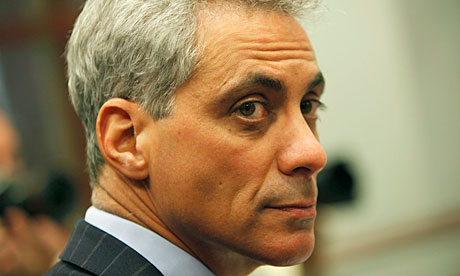
Rahm Emanuel

Former White House chief of staff and now Chicago Mayor Rahm Emanuel. Photograph: Aude Guerrucci/POOL/EPA

It's almost as if Rahm Emanuel was lifting a page from Naomi Klein's Shock Doctrine – as if he was reading her account of Milton Friedman's "Chicago Boys" as a cookbook recipe, rather than as the ominous episode that it was. In record time, Emanuel successfully exploited the fact that Chicago will host the upcoming G8 and Nato summit meetings to increase his police powers and extend police surveillance, to outsource city services and privatize financial gains, and to make permanent new limitations on political dissent. It all happened – very rapidly and without time for dissent – with the passage of rushed security and anti-protest measures adopted by the city council on 18 January 2012.

Sadly, we are all too familiar with the recipe by now: first, hype up and blow out of proportion a crisis (and if there isn't a real crisis, as in Chicago, then create one), call in the heavy artillery and rapidly seize the opportunity to expand executive power, to redistribute wealth for private gain and to suppress political dissent. As Friedman wrote in Capitalism and Freedom in 1982 – and as Klein so eloquently describes in her book:

"Only a crisis – actual or perceived – produces real change. When the crisis occurs, the actions that are taken depend on the ideas that are lying around. That, I believe, is our basic function … until the politically impossible becomes politically inevitable."

Today, it's more than mere ideas that are lying around; for several decades now, and especially since 9/11, there are blueprints scattered all around us.

Step 1: hype a crisis or create one if there isn't a real one available. Easily done:with images from London, Toronto, Genoa, and Seattle of the most violent anti-G8 protesters streaming on Fox News and repeated references to anarchists and rioters, the pump is primed. Rather than discuss the peaceful Occupy Chicago protests over the past three months, city officials and the media focus on what Fraternal Order of Police President Michael Shields calls "people who travel around the world as professional anarchists and rioters" and a "bunch of wild, anti-globalist anarchists". The looming crisis headlines Rahm Emanuel's draft legislation, now passed: "Whereas, Both the North Atlantic Treaty Organization ("Nato") and the Group of Eight ("G8") summits will be held in the spring of 2012 in the City of Chicago" and "whereas, the Nato and G8 Summits continue to evolve in terms of the size and scope, thereby creating unanticipated or extraordinary support and security needs …" The crisis calls for immediate action.

Step 2: rapidly deploy excessive force. Again, easily done: Emanuel just gave himself the power to marshal and deputize – I kid you not, look at page 3 – the United States Drug Enforcement Administration (DEA), the Federal Bureau of Investigation (FBI), the United States Department of Justice's Bureau of Alcohol, Tobacco, and Firearms (ATF), and the entire United States Department of Justice (DOJ); as well as state police (the Illinois department of state police and the Illinois attorney general), county law enforcement (State's Attorney of Cook County), and any "other law enforcement agencies determined by the superintendent of police to be necessary for the fulfillment of law enforcement functions".

As one commentator suggests, the final catch-all allows Emanuel to hire "anyone he wants, be they rent-a-cops, Blackwater goons on domestic duty, or whatever. For a city that has great problems keeping its directly sworn officers in check, this looser authority is an even greater license for abuse." Thanks to the coming G8 meeting, the Chicago police department has just gotten a lot bigger! According to Fox News, "there will be hundreds, perhaps thousands of federal agents here."

Not just that, but Emanuel has also given himself the power to install additional surveillance, including video, audio and telecommunications equipment. And not just for the period of the G8 and Nato summits, but permanently. These new provisions of the substitute ordinance apply "permanently": there is no sunset provision on either the police expansion or the surveillance. On this second, the new ordinance reads:

"The superintendent is also authorized to enter into agreements with public or private entities concerning placement, installation, maintenance or use of video, audio, telecommunications or other similar equipment. The location of any camera or antenna permanently installed pursuant to any such agreement shall be determined pursuant to joint review and approval with the executive director of emergency management and communications." [my emphasis]

Thanks to the mobilization of the Occupy movement (including their funeral for the Bill of Rights) and other groups like the ACLU, some of Emanuel's other draconian provisions were scaled back. Emanuel dropped his proposals to increase seven-fold the minimum fine for resisting arrest (including for passive resistance) from $25 to $200, to double the maximum fine for resisting arrest from $500 to $1,000, and to double the maximum fine for violations of the parade ordinance from $1,000 to $2,000. But the rest of his proposals – including the three-fold increase in the minimum fine for a violation of the parade ordinance – passed the City Council Thursday.

Step 3: privatize the profits and socialize the costs. In Chicago, that translates into Emanuel outsourcing city services to private enterprises, but making sure the public will indemnify those private companies from future law suits. This is a two-part dance with which we have become all too familiar.

First, city services are outsourced, often to circumvent labor and other regulations, and the income side of the public expenditures are shifted over to private enterprise and employees. Under the ordinance (see page 4):

"The mayor or his designees are authorized to negotiate and execute agreements with public and private entities for good, work or services regarding planning, security, logistics, and other aspects of hosting the Nato and G8 summits in the city in the Spring of 2012 … and to provide such assurances, execute such other documents and take such other actions, on behalf of the city, as may be necessary or desirable to host these summits."

Second, the agreements can be entered "on such terms and conditions as the mayor or such designees deem appropriate" and these terms include, importantly, "indemnification by the city". In other words, any lawsuits will fall on the city taxpayers. The public will be left holding the bag if there is, for instance, police abuse or other mismanagement by private employers.

Step 4: use the crisis to expand executive power permanently and repress political dissent. Most of the ordinance revisions, it turns out, do not sunset with the departure of the G8 or Nato delegates. To be sure, there's a sunset provision for those contracts that specifically involve "hosting the Nato and G8 summits." That provision expires on 31 July 2012; but not the expanded police powers, nor the increased video surveillance, nor the other changes to the protest permit requirements.

The new rules affecting permits for protests and marches include details that impose onerous demands on dissent. As noted earlier, the minimum fine for a violation of the parade ordinance will increase from $50 to $200. On the parade permit applications, the protest organizers now must provide a general description of any sound amplification equipment that is on wheels or too large for one person to carry and/or any signs or banners that are too large for one person to carry. These may sound like small details, but they are precisely the kinds of nitpicking regulations that empower and expand police discretion to arrest and fine, and that make it harder to express political opinions.

It's another glaring example of what I have called The Illusion of Free Markets and the paradox of "neoliberal penality": the purported liberalization of the economy (here, the privatization of city services) goes hand-in-hand with massive policing. Scott Horton captured the idea well in Harper's, under the rubric "The Despotism of Natural Law". Notice the neoliberal paradox: the fact that the city claims to be incompetent or unable to performs its ordinary functions implies that we need to both outsource city services and augment city police powers.

It was accomplished so quickly and seamlessly – passed practically overnight – that few seem to have noticed or had time to think through the long-term implications. There's not a mention in the New York Times and only a small story in the Chicago Tribune. The crisis and fear of outside agitators, professional anarchists and rioters – splashed on the TV screens direct from London, Toronto, Genoa, Rome, or Seattle – is enough to create a permanent state of exception.

To make matters worse, this cookbook implementation of mini shock treatment follows on the heels of a severe crackdown on the Occupy Chicago movement that resulted in the arrest of over 300 Occupy protesters in Grant Park in October 2011. The prosecutions are still ongoing today and the effect on political dissent has been chilling.

In those 300 arrests, Rahm Emanuel and his police chief rigidly enforced a park curfew without finding reasonable ways to accommodate the political speech interests of the protesters, and beyond any semblance of a legitimate governmental interest. The massive arrests raise a clear first amendment problem – one that has been raised by the Occupy protesters and will be heard en masse at the Daley Center on 15 February. (Ironically, Emanuel and his police will effectively "Occupy the Daley Center".)

The first amendment argument is compelling, especially when you consider the disparate treatment that political expression receives in Chicago. Recall, for instance, how different things were in Grant Park on election night 2008. Huge tents were pitched, commercial sound systems pounded rhythms and political discourse, enormous TVs streamed political imagery. More than 150,000 people blocked the streets and "occupied" Grant Park – congregating, celebrating, debating and discussing politics. That evening, President-elect Barack Obama would address the crowds late into the night and the assembled masses swarmed the park to the early morning hours. It was a memorable moment, perhaps a high point in political expression in Chicago.

Well, that was then. The low point would come three years later, almost to the day. On the evening of 15 October 2011, thousands of Occupy protesters marched to Grant Park and assembled at the entrance to the park to engage, once again, in political expression. But this time, the assembled group found itself surrounded by an intimidating police force, as police wagons began lining up around the political assembly. The police presence grew continually as the clock approached midnight.

Within hours, at the direction, ironically, of President Obama's former chief-of-staff (was Rahm Emanuel at Grant Park after hours, a few years earlier?), the Chicago Police Department began to arrest the protesters for staying in Grant Park beyond the 11pm curfew in violation of a mere park ordinance.

Emanuel could have ordered his police officers to issue written citations and move the protesters to the sidewalk. In fact, that's precisely what the police would do a few weeks later at a more obstreperous protest by senior citizens at Occupy Chicago. On that occasion, 43 senior citizens who stopped traffic by standing or sitting in the middle of a downtown street were escorted by police officers off the street without being handcuffed, and were merely issued citations to appear in the department of administrative hearings. (Those arrests, however, took place under the watchful eye of Democratic Senator Dick Durbin and Democratic Representatives Danny Davis, Jan Schakowsky and Mike Quigley.)

But not on 15 October or the following Saturday night. Instead of issuing citations, the Chicago police arrested over 300 protesters, placed them in handcuffs, treating the municipal park infractions as quasi-criminal charges, booked them, fingerprinted them and detained them overnight in police holding cells, some for as many as 17 hours. They are now aggressively prosecuting these cases in criminal court.

That's precisely the type of practice that chills political expression. The inconsistent treatment of political dissent in Grant Park or at the Chicago board of trade reflects the colossal amount of discretion that mayors and police chiefs have over political discourse today. Police discretion is wide, political expression is fragile.

Rahm Emanuel's message on the G8 and Nato meetings has been loud and clear – and chilling: the DEA, FBI, ATF, DOJ, state police and many other law enforcement agencies will be out in force; it will be harder to comply with the protest laws; and any deviations or errors will be costlier and punished. What's really troubling is that the G8 and Nato will come and go, but these reforms are with us in Chicago to stay. Chicago's mayor seems to be following in the footsteps of other municipal officials (recall Rudy Giuliani's idea of staying on as mayor for an extra three months), who, with a touch of Potus-envy and perhaps a small Napoleonic complex, begin to act like minor tyrants.

It'll be interesting to follow the first amendment litigation brought by the Occupy protesters. Their cases have been joined – there are about 100 of them in the challenge now – and their free speech claims will be heard by the chief judge at the Daley Center on 15 February 2012.