Wednesday, December 28, 2011

Eddie Conway Update - January 2012


Revolutionary Greetings, to all my family, friends, and supporters.
The last few months have been a very busy time for me. I am very
happy to report that some progress has been made in several areas.
The best news to date is the progress with my parole situation. Since
my last update letter, my lawyer filed a request for a parole hearing
for me. I had the hearing on November 30, 2011. I met with two
commissioners and they decided to advance my case to the next level
of the parole process for persons with life sentences. That level
requires a psychological evaluation, which means that sometime in the
near future I will be transferred to another institution for a three
month evaluation. This whole process is called a Risk Assessment, and
once this level is completed the case goes before the full body of
the parole commission. There are ten commissioners and a majority
vote is required before the case can be sent to the governor who has
the final right to approve or deny.

Thanks to all of you who wrote support letters or sent cards. One of
the key reasons for moving my case forward was the enormous amount of
community support reflected by those letters and cards. You all
really helped, thank you once again. For those who did not know that
this process was underway, it happened fast, but there is still time
for you to write. The case will go before the full commission and the
members will once again read the letters of support. So please
continue to send letters requesting parole
to:

Mr. David Bloomberg
6776 Reisterstown Rd.
Baltimore, MD. 21215

My lawyer, Phillip Dantes and his legal team has committed to filing
my case in court by the end of this year 2011. As of this writing,
that schedule is still being honored. We are looking forward to being
in court sometime in 2012. Once we have a date, I will make you all
aware via facebook and an update letter. We will be organizing a
fundraiser in the spring to help with legal and court costs.

Since my last letter I have had the opportunity to speak at a number
of events. I spoke with students and activist at University of
Michigan-Ann Arbor, University of California at Riverside, and
Students Against Mass Incarceration at Howard University. I also
spoke at several community events and book readings of Marshall Law
The Life and Times of a Baltimore Panther: the Urban Network in
Detroit, MI., Internationalist Books in Chapel Hill, N.C., and
readings in Chicago, Ill., and in Baltimore, MD. Some of these events
also included large groups form Occupy Riverside, CA. and Occupy
Chicago, plus students from University of North Carolina. In October
I participated in a conference of community leaders and activists
like Leaders of a Beautiful Struggle organized by Dylan Rodriguez
with the American Studies Association; their annual meeting was held
in Baltimore. I also had the opportunity to meet and speak with
National Black United Front members who visited me and offered some
encouragement for the survival of our community.

The work we are doing with the Friend of a Friend (FOF) mentoring
organization is going very well. The organization has developed so
many positive community leaders and mentors that I can no longer keep
up with all the new people around the system and out in the
community; that is a good thing and I am happy with both the group's
growth and direction. The (FOF) prison project is expanding into
another prison- with one more wanting the program; it is currently in
five Maryland prisons.

I will never be able to thank the American Friends Service Committee
(AFSC) for taking on this task and helping us save hundreds of lives
and put many positive activists back into the community. We are now
organizing our families outside with the support of a local church,
Pleasant Hope Baptist Church and Pastor Heber Brown. Members of a
Friend of a Friend are working with a local school to help provide
guidance to youth; they are starting a Freedom School in 2012, and
are also speaking at colleges in the region.

Our Neutral Grounds project has opened up a snack and beverage stand
to demonstrate our concept of "Do for Self". Since unemployment is
highest among people of African descent and even higher among former
prisoners we have to think of ways to employ ourselves, and create
our own economic opportunity. My family is okay in general. However,
I recently lost a brother-in-law; he was married to my sister for
thirty-nine years. Many of the family are planning a large holiday
dinner and I plan to call in to the gathering. I am still struggling
with high blood pressure, but I am exercising and trying to eat
right, but prison food only allows so much right eating.

One thing I wish I could do better is write everyone as soon as the
mail comes in, it's just not possible, but I greatly appreciate every
letter - thank you all. I am looking forward to the coming year, and
hope to see positive changes in the world. 2012 is an important year
for our community and as the economic picture continues to change and
capitalism collapses, food and basic needs will be in greater demand
for the most vulnerable people in our communities. We need to learn
and teach everyone how to grow our own food in local city gardens,
and meet our needs collectively. Block by block - help rebuild the
community- grew something to eat!

In Struggle,
Eddie Conway

via - Dominque Stevenson

Mass Black Incarceration Ending? Don't Hold Your Breath

Dec. 27, 2011 Black Agenda Report

A Black Agenda Radio commentary by Glen Ford

It’s been two generations since the beginning of modern mass Black incarceration. Prison populations, which only doubled from 1925 to 1972, increased more than seven-fold over the next 38 years, with Blacks accounting for ever higher proportions of inmates. The latest statistics do not indicate that white people “have reconsidered – or even acknowledged – their extraordinarily broad support for placing more Black people in captivity over the past 40 years than at any time since slavery.”

Mass Black Incarceration Ending? Don't Hold Your Breath

A Black Agenda Radio commentary by Glen Ford

Half of the states reported decreases in their prison populations.”

For the first time since 1972, the total number of people held in U.S. prisons has gone down. And, for the second year in a row, the number of persons under supervision – such as parole – by state departments of correction, decreased.

Does this mean the beginning of the end of mass Black incarceration in the United States? Not hardly. That would require an historic reversal of a nationwide policy to find new places to put Black people who refused to stay “in their place,” in the wake of the Civil Rights and Black Power Movements. There is little in the current American political conversation that indicates white people have reconsidered – or even acknowledged – their extraordinarily broad support for placing more Black people in captivity over the past 40 years than at any time since slavery.

It takes the government almost a year to tabulate the past year’s prison statistics, so the latest numbers are from 2010. They show about 7.1 million people under some kind of correctional supervision – one out of every 33. That’s down 1.3 percent from 2009, the year that saw the first decrease in supervision in two generations. The total population in state and federal prisons – not counting local jails – stood at 1.6 million inmates, down six-tenths of one percent. State prison populations decreased by almost 11,000, and local jails by almost 19,000, but federal prison populations grow by eight/tenths of one percent, to almost 210,000 inmates. That was, however, the smallest percentage increase in a generation – since 1980.

Half of the states reported decreases in their prison populations, with California and Georgia shrinking the most.

Twenty-four states and the federal prison system increased their inmate populations.”

Speculation on why prison populations have, at least temporarily, peaked, centers on the financial crisis. It is true that states are experiencing unprecedented difficulties paying their bills. Some states have clearly responded to their fiscal crises by finding ways to incarcerate fewer people. Michigan reduced its prison population by 6,000 inmates in three years, mainly by decreasing the number of inmates who wind up serving more time in jail than they were originally sentenced to. California is under court order to cut its prison population by 30 percent, or 40,000 inmates. But the court order came too late to have a significant effect on 2010 prison numbers.

Only half the country has seen any decrease, at all. Twenty-four states and the federal prison system increased their inmate populations, with Illinois, Texas and Arkansas leading the pack. And states have found other ways to cut down on inmate costs without putting fewer people in prison, through wholesale privatization of prisons, and imposition of draconian fees on prisoners, probationers and parolees.

The Pew Research Center on the States cites programs that divert some offenders to probation, and accelerated release of low-risk inmates. However, studies have shown that such diversion programs tend to serve disproportionately white offenders. Therefore, it is highly premature for anyone to speculate that the era of mass Black incarceration may be ending. For the foreseeable future, one out of eight of the world’s prison inmates will continue to be African American.

For Black Agenda Radio, I’m Glen Ford. On the web, go to BlackAgendaReport.com.

BAR executive editor Glen Ford can be contacted at Glen.Ford@BlackAgendaReport.com.

Occupy Indonesia: Anti-mine Protesters Burn Government Buildings, Banks, Two Protesters Killed

Dec. 26, 2011 Earth First! Newswire

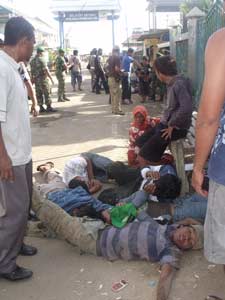
Two protesters have been killed and 10 others injured during a raucous
protest over a planned goldmine, co-owned by an Australian company, in
eastern Indonesia.

The victims were among nearly 1000 people in Lambu village in West
Nusatenggara province trying to stop the goldmining project by Australia’s
Arc Exploration and its Indonesian partner, PT Sumber Mineral Nusantara.

The villagers fear the project will destroy their land and threaten
forests and water resources.

National police spokesman Major-General Saud Usman Nasution says police
were forced to fire on Saturday’s protest after demonstrators burnt down
dozens of government buildings, banks and homes.

Nasution said that police arrested 47 people involved in the protest,
which disrupted port and ferry services in the coastal town of Sape.

Police defended their use of force on Sunday after the deaths of two men
they shot while trying to disband a mob occupying the Sape port on Sumbawa
island who were protesting a local mine.

“The protest by occupying and prohibiting activities at the Sape ferry
harbor since December 20 disturbed the activities of society,” National
Police spokesman Insp. Gen Saud Usman said.

Police said the absence of ferry services had caused unrest among the
people, prompting law enforcement to act. Saud also accused the protestors
of “using women and children as shields” and refusing to negotiate.

Three “provocateurs” were arrested along with 44 others, including six
children, for questioning. Saud said police had confiscated 10 machetes,
four sickles, one spear and several fuel bombs from the protestors.

He identified those killed as Arief Rachman, 18, and Syaiful,17. Eleven
others were wounded.

Lahmuddin from the National Student League for Democracy said people
angered by reports of the shooting attacked and burned several buildings
including village halls, subdistrict offices and the houses of several
people known to work for the mining firm they were protesting against,
Sumber Mineral Nusantara.

National Police assistant for operations Insp. Gen. Badrodin Haiti
justified the shooting, saying the protesters were armed with machetes,
spears and knives.

“If a protest clearly runs against the law by trying to enforce a wish,
should it be allowed to happen?” Badrodin said, adding that the port was
crucial to the local economy. “We tried to persuade them [to disband] but
failed. I am not blaming the personnel in the field.”

He insisted the shots had not been aimed to kill. “The personnel, of
course, never had the intention to kill anyone,” he said.

Hundreds of students held rallies in Mataram and Bima, West Nusa Tenggara,
burning furniture they had removed from the district council building. The
district council accused police of “arrogance” and vowed to form a
fact-finding team.

Several religion-based student organizations issued a joint statement on
Sunday accusing the police of failing in their reforms and of being
“repressive.”

Mass protests in Homs as Arab monitors visit

Estimated 70,000 demonstrate in Syria's protest hub, with Arab League
observers expected to return on Wednesday.

Dec. 27, 2011 Al Jazeera


Syrian government forces have reportedly fired tear gas and live rounds at
thousands of protesters in Homs, as Arab League monitors finished their
first day of observation in the city that has been the centre of the
anti-government protest movement.

Arab League peace monitors are on a mission to assess whether Syria has
halted its nine-month crackdown on protests against President Bashar
al-Assad.


The delegation met the governor and toured Homs on Tuesday. They will
continue touring the area on Wednesday, the Syrian television channel
Dunia said.

"I am returning to Damascus for meetings and I will return tomorrow to
Homs," Sudanese General Mustafa Dabi, head of the mission, told the
Reuters news agency. "The team is staying in Homs. Today was very good and
all sides were responsive".

This came as activist groups said 35 people had been killed across the
country on Tuesday. Activists earlier said dozens of people were killed in
Homs on Monday.

The 50 observers, who arrived in Syria on Monday, are split into five
teams of 10, according to Reuters.

Teams are also visiting Damascus, Hama and Idlib.

Mass protests

Activists, meanwhile, reported that some 70,000 protesters have tried to
march to the centre of Homs, and that security forces have been firing
tear gas in an attempt to break up the protests.

The Syrian Observatory for Human Rights earlier said a group was gathering
in Khalidiya, one of the four parts of Homs where there has been heavy
bloodshed as armed rebels fight security forces using tanks.

Footage posted online showed big crowds of anti-government protesters in
the neighbourhoods of Bab Sbaa and Khaldiyeh and a funeral march in Ghouta
area. Pro-Assad rallies were also reported in two other neighbourhoods.

Witnesses said the army pulled back tanks from Bab Amr, a flashpoint
neighbourhood in the city, ahead of the observers' arrival on Tuesday.
However, some activists said tanks had just been repositioned in other
areas of the city.

Also in Homs province on Tuesday, the SANA state news agency reported that
saboteurs blew up a gas pipeline in the area.

The latest explosion, blamed on "terrorists", is the fifth reported attack
on energy infrastructure since the outbreak of Syria's unprecedented
pro-reform protest movement in mid-March.

Arab monitors


Residents of Bab Amr try to talk to Arab League observers

Activists uploaded video footage onto the internet, which reportedly shows
residents of Bab Amr trying to speak to the Arab monitors, although Al
Jazeera cannot independently verify this.

"It shows a group of people from the Bab Amr neighbourhood having a
conversation with what we believe are members of the Arab League observer
mission," said Al Jazeera's Zeina Khodr, reporting from the Turkish town
of Antakya, near the border with Syria.

"They seem very desperate, and they seem as if the Arab League observers
are really their last hope. You hear the man telling them 'Come to my
neighbourhood, come to my street, people here are dying, there are snipers
on rooftops, we are not able to walk in the street'."

Khodr continued: "He repeatedly stresses the fact that 'We are unarmed, we
are unarmed civilians.'. Now this is what the protesters want the Arab
League to see, that they are not responsible for the violence but that
they have been victims of the violence," Khodr said.

Bab Amr has seen some of the heaviest fighting in recent months. A
resident also told Al Jazeera on Tuesday that people there were being
prevented from meeting with Arab League observers.

"More than 10,000 people here in Bab Amr have gone out to demonstrate so
they [security forces] are shooting randomly to prevent them from seeing
anyone," the resident said.

"There is a lot of tanks here in Bab Amr, but they are trying to hide
them... We can't see them [Arab League observers], we can't speak with
them, they are walking with the security forces. We can't reach them and
contact them."

'Element of surprise'

During their mission, the observer teams will use government transport,
according to their top official, General al-Dabi. Delegates insist the
mission will nevertheless be able to go wherever it chooses with no
notice.

"Our Syrian brothers are co-operating very well and without any
restrictions so far," al-Dabi told the Reuters news agency.

Other delegates said they expected to be able to "move freely between
hospital, prisons and detention centres all over Syria".

"The element of surprise will be present," Mohamed Salem al-Kaaby, a
monitor from the United Arab Emirates, said.

"We will inform the Syrian side the areas we will visit on the same day so
that there will be no room to direct monitors or change realities on the
ground by either side."

The observers' mission is part of a plan seeking to put an end to the
government's crackdown, which the United Nations estimates to have killed
more than 5,000 people since March.


Mass anti-Assad protest in Homs as monitors visit

By Mariam Karouny and Erika Solomon | Reuters – Dec. 27, 2011

BEIRUT (Reuters) - Tens of thousands of Syrians have taken to the streets
in the flashpoint city of Homs to rally against President Bashar al-Assad
and plead for newly-arrived Arab peace monitors to bear witness to their
plight.

About 70,000 protesters marched towards the city centre on Tuesday where
security forces fired at them and lobbed teargas, activists said.

The military withdrew some tanks, in what the activists called a ploy to
persuade the monitors that the city was calm. Footage on the Internet
showed monitors confronted by residents as gunfire crackled around them.

The Arab League observers, who arrived in the country on Monday, want to
determine if Assad is keeping his promise to implement a peace plan to end
his military crackdown on nine months of popular revolt.

The monitors were due to return on Wednesday to Homs where crowds have
pleaded for them to visit the most violent neighborhoods. Activists say
tanks ran amok and scores of people have been killed in recent days.

Live broadcasts by Al Jazeera television showed tens of thousands of
protesters gathered on Tuesday in the Khalidiya district - one of those
yet to be visited by monitors - shouting and whistling and waving white
flags.

One activist held up a sign to the camera that read: "We are afraid when
the monitors leave they will kill and bury us."

The observers' visit is the first international intervention on the ground
in the country since the uprising began, and protesters hope what they
witness will prompt world powers to take more decisive action against
Assad.

The Syrian leader says he is fighting an insurgency by armed terrorists,
and that most of the violence has been aimed at the security forces.
International journalists are mostly barred from Syria, making it
difficult to confirm accounts.

The Syrian Observatory for Human Rights, a British-based activist group,
said security forces killed 15 people across the country on Tuesday, six
of them in Homs. An activist network said 34 had been killed on Monday.

Some protesters shouted "We want international protection" in a video
posted on YouTube apparently showing an encounter with the monitors on
Tuesday. Some residents argued and pleaded with them to go further into
the Baba Amr quarter, where clashes have been especially fierce.

There was the sound of gunfire after a resident yelled at one monitor to
repeat what he had just told his headquarters.

"You were telling the head of the mission that you cannot cross to the
second street because of the gunfire. Why don't you say it to us?" the man
shouted, grabbing the unidentified monitor by his jacket.

Gunshots crackled nearby as two monitors and two men wearing orange vests
stood amid a crowd of residents, one begging the team to "come and see;
they are slaughtering us, I swear."

The head of mission said the first visit was "very good."

"I am returning to Damascus for meetings and I will return tomorrow to
Homs," Sudanese General Mustafa Dabi said. "The team is staying in Homs.
Today was very good and all sides were responsive."

Activist reports just before the monitors arrived on Tuesday said up to a
dozen tanks were seen leaving Baba Amr and others were being hidden to
fashion an impression of relative normality in the city while observers
were around.

"My house is on the eastern entrance of Baba Amr. I saw at least six tanks
leave the neighborhood at around 8 in the morning (0600 GMT)," activist
Mohamed Saleh told Reuters by telephone. "I do not know if more remain in
the area."

Al Jazeera's footage showed thousands of Syrians in the square in
Khalidiya, one of four districts where there has been bloodshed as rebels
fight security forces using tanks.

They were whistling and shouting and waving flags, playing music over
loudspeakers and clapping.

The protesters shouted "We have no one but God" and "Down with the
regime." An activist named Tamir told Reuters they planned to hold a
sit-in in the square.

"We tried to start a march down to the main market but the organizers told
us to stop, it's too dangerous. No one dares go down to the main streets.
So we will stay in Khalidiya and we will stay here in the square and we
will not leave from here."

WASHINGTON CONDEMNS VIOLENCE

The U.S. State Department condemned what spokesman Mark Toner called an
escalation of violence before the monitors' deployment.

"We have seen horrific pictures of indiscriminate fire, including by heavy
tank guns, and heard reports of dozens of deaths, thousands of arrests, as
well as beatings of peaceful protestors," Toner said.

"The monitors should have unfettered access to protestors and to areas
most severely affected by the regime's crackdown. They bear a heavy
responsibility in trying to protect Syrian civilians from the depredations
of a murderous regime."

"If the Syrian regime continues to resist and disregard Arab League
efforts, the international community will consider other means to protect
Syrian civilians."

Armed insurgency is eclipsing civilian protest in Syria. Many fear a slide
to sectarian war between the Sunni Muslim majority, the driving force of
the protest movement, and minorities that have mostly stayed loyal to the
government, particularly the Alawite sect to which Assad belongs.

Analysts say the Arab League is anxious to avoid civil war. Western powers
have shown no desire to intervene militarily in a volatile region of
Middle East conflict. The U.N. Security Council is split, with Russia - a
major arms supplier to Assad - and China opposed to any hint of military
intervention.

Assad's opponents appear divided on aims and tactics. He still has strong
support in important areas, including Damascus and the second city Aleppo,
and maintains an anti-Israel alliance with Iran.

(Additional reporting by Ayman Samir; Editing by Peter Graff)

Monday, December 26, 2011

The Story Behind the Occupy Seattle Artist House Raided Last Night by a SWAT Team

Cammi Morgan with the key anonymously given to occupiers

Dec. 24, 2011 by The Stranger

As Central District News reported, police last night raided a house at 19th and Spruce, arresting three men for charges including "Criminal Trespassing, Property Damage and weapons violations. Other criminal charges may be forthcoming."

According to the SPD's account, the raid was in response to a 911 call that afternoon that alerted them about "multiple male and female subjects who had unlawfully entered and occupied a residence. ...Preliminary investigation indicates that the suspects entered the house and subsequently damaged the interior of the house with graffiti. They also left garbage, open containers of food, and were cooking inside the house on a portable, gas-operated stove."

The house had been bought out of foreclosure in August by Mountaincrest Credit Union, according to CDN. The way the CDN story reads, the house was under renovation and the occupiers were interrupting progress and damaging it—and they'd broken in.

This mural on Fir Street between 14th and 15th was painted yesterday, by Drinkwater, the same Occupy artist who created the Rise & Decolonize banners for the recent port action.
  • Neil Vandervloed
  • This mural on Fir Street between 14th and 15th was painted yesterday, by Drinkwater, the same Occupy artist who created the Rise & Decolonize banners for the recent port action.
But that story doesn't match what I learned in a meeting just now with two of the 10 or 12 occupiers who had been in the house for about two weeks.

They held up the house key. An anonymous "elf" had come by the Occupy Seattle encampment at SCCC a few weeks ago and handed them the key and the address, they said. (A different anonymous donor also gave them a sailboat that they'll begin using and painting in the spring.) Inside, they'd begun painting a forest landscape, and planned a waterfall down the staircase; they titled the house "Water." They denied doing damage or being a haven for any kind of destructive activity and said they didn't know of any complaints from neighbors. Instead, they saw the house as a home base for adding art to the immediate neighborhood. To that end, they'd completed a mural nearby yesterday, on Fir Street between 14th and 15th, on a garage wall offered to them by a resident. Also yesterday, another donor gave them furniture: a futon, bookcases.

Two of their fellow occupiers are still in jail, set to be released on bail this afternoon. The third person arrested was not part of the occupation and never had lived in the house, they say. He, along with about 50 other protesters against the raid, had come to show his support, and when he stepped onto the grass, he was arrested, the occupiers say. He is the one charged with weapons violations, they say: He had a pocket knife in his pants pocket, which he then offered to the police, for which they booked him on the weapons charge.

Another painting made by Drinkwater during the occupation at the house at 19th and Spruce.
  • Neil Vandervloed
  • Another painting made by Drinkwater during the occupation at the house at 19th and Spruce.
The police did not give the squatters 72 hours eviction notice, and when Cammi Morgan, one of the occupiers, asked whether the police had any contact with the property owner, they said no, she says. It is unclear why the scenario at 19th and Spruce is so different from the other house where Occupy Seattle is squatting, at 23rd and Alder—where anarchist squatters have a court date December 28 and have had plenty of notice of removal.

"This house wasn't about anti-police at all," Morgan says. "Our intention was to show that we could give back to the community. It wasn't about having a roof over our heads—we're all pretty resourceful. We were excited to use the house as a pathway to create art for everyone. We'd offered to touch up the fading murals at the food bank at Saint Mary's. I wanted to offer guitar lessons at the boys and girls club near there."

Neil Vandervloed, creator of the cartoon hand signs that have been the most visible graphic for Occupy Seattle, was bringing community dinners cooked by his wife to the house each night.

"I'm really disappointed," Vandervloed said. "Especially this type of reaction. There were something like 13 cop cars and 30 cops there, with assault rifles, shotguns, and handguns out and drawn—to arrest two artists on Christmas Eve. The neighbors made us hot coffee and stood in solidarity with us as the police raided."

Cuba to free nearly 3,000 prisoners

December 24, 2011 ABC News

Cuba will release 2,900 prisoners in the coming days for humanitarian reasons in a sweeping amnesty ahead of a visit next year by Pope Benedict XVI, the Cuban government said on Friday.

Those to be pardoned do not include American Alan Gross, serving 15 years in prison for setting up internet equipment on the island under a secretive US program in a case that stalled progress in US-Cuba relations, a government spokesman said.

The ruling Council of State granted the amnesty in a decision that president Raul Castro, in a separate speech to the National Assembly, said had "taken into account" the upcoming papal visit and requests by top Roman Catholic Church officials in Cuba and family members of the prisoners.

The action showed the "generosity and strength" of the Cuban revolution, he said in a speech to the National Assembly.

Those to be released included some who had been convicted for crimes against "the security of the state," but the government spokesman said they were not jailed for political reasons.

Cuba freed more than a 100 political prisoners in a deal brokered by the Catholic Church in 2010. Cuban dissidents have said there are still at least 60 people behind bars for political reasons.

Elizardo Sanchez, head of the independent Cuban Commission on Human Rights, downplayed the importance of the prisoner release.

It's a shallow measure by the government, a gesture to improve its international image," he said.

The freed prisoners will include persons more than 60 years of age, prisoners who are ill, women and some young prisoners who had no previous criminal history, the government said.

Mr Castro said 86 of the prisoners are foreigners from 25 countries who committed crimes in Cuba, but they would be released only if their countries agreed to repatriate them.

The US State Department declined to comment on the amnesty and its failure to include Gross, but has repeatedly said in the past that he was only providing internet access for Jewish groups in Cuba and should be released immediately.Gross was working as a subcontractor in a US-funded program promoting political change in Cuba.

The Cuban government considered it subversive. His arrest halted a brief warming in US-Cuba relations that have been hostile since Fidel Castro embraced Soviet Communism after his 1959 revolution.

Pope Benedict said recently he would visit Cuba before Easter, which falls on April 8. It would be the second papal visit to Cuba since Pope John Paul II's historic trip in 1998.

After that visit, in which the pontiff criticized the US trade embargo against Cuba, the Cuban government freed about 300 prisoners, including 101 political prisoners. The others were in jail for common crimes.

Minor prisoner releases have taken place over the years, usually as a goodwill gesture accompanying the visit of a dignitary such as former US president Jimmy Carter or other foreign representatives.

Cuba freed 3,600 political prisoners after then Cuban leader Fidel Castro met with exiles in 1978 during Carter's presidency.

Many Cubans had expected Mr Castro to announce a liberalization of immigration rules that would make it easier for them to travel abroad, but he said only that it was being worked on and changes would be made gradually.

Lori Berenson arrives in U.S. after 16 years

December 20, 2011|By Mariano Castillo, CNN

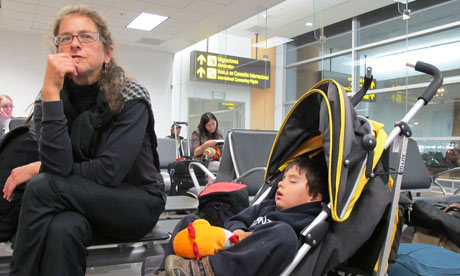
Lori Berenson, the American activist convicted of aiding terrorists in
Peru, arrived in the United States Tuesday morning for the first time
since her 1995 arrest.

Berenson arrived at the Newark Liberty International Airport just past
7:30 a.m. An hour later, she emerged from the terminal pushing a luggage
cart and with her 2-1/2-year-old son at her side.

She exited the terminal without saying a word to reporters and boarded a
waiting sedan with her mother and drove off.

A previous attempt by Berenson, currently on parole, to visit the United
States for the holidays was foiled Friday because she lacked some
paperwork.

She will spend the holidays with her family in New York.

Last week, Berenson's lawyer, Anibal Apari, called the decision to block
her from leaving as "arbitrary," and said he wanted to get to the bottom
of who gave the order.

But a Peruvian immigration official later said that Berenson lacked a
document from his office, which she received Monday, the state-run Andina
news agency reported.

Berenson was sentenced to life in prison in 1995 for collaborating with
the Tupac Amaru Revolutionary Movement to attack the nation's Congress and
overthrow the government. Her sentence was reduced to 20 years on appeal.

She was released from Lima's Chorrillos Penitentiary in November 2010
after a Peruvian court granted her parole. As a parolee, Berenson must
remain in Peru until at least 2015.

Under the travel terms set by her immigration paperwork, Berenson, 42, has
to return to Peru by January 11.

In 2009, while in prison, Berenson gave birth to a son who was fathered by
Apari, her estranged husband who is also her attorney. The boy lived with
her in prison until her release.

Lori Berenson returns to the US

Paroled American activist convicted of helping Peruvian guerillas allowed
home after initially being prevented from boarding flight

Associated Press in Lima
guardian.co.uk, Tuesday 20 December 2011

Lori Berenson with her son at Lima international airport before boarding a
plane to the US. Photograph: Frank Bajak/AP

The American activist Lori Berenson, who stirred international controversy
after being convicted of helping Peruvian guerrillas, is returning to the
US for her first visit since Peruvian authorities arrested her in 1995.

The 42-year-old, who is on parole, boarded a Continental Airlines flight
at Lima's main airport under intense media scrutiny.

Berenson's departure capped three days of confusion after Peruvian
authorities prevented her from boarding a flight to New York on Friday
despite a court approval allowing her to leave. The court has ordered her
to return to Peru by 11 January.

The authorities said Berenson, who had served 15 years on an accomplice to
terrorism conviction before her parole last year, lacked an additional
document.

Peruvian migration officials finally gave Berenson another document on
Monday clearing her to leave the country with her son.

Her father, Mark Berenson, said he was anxious to see her return.

"I'm just glad that they finally resolved the thing," he said.

Lori Berenson admitted helping the Tupac Amaru rebel group rent a safe
house where authorities seized a cache of weapons after a shootout with
the rebels. She insists she did not know guns were stored there and says
she never joined the group.

In 1996, a military court of hooded judges convicted Berenson of treason
and sentenced her to life in prison. After US pressure, she was retried by
a civilian court.

Her father said his daughter had every intention of returning to Peru.

By law, she must remain in Peru until her full sentence lapses unless the
president, Ollanta Humala, decides to commute it.

Peru remains deeply scarred from its 1980-2000 conflict, which claimed
about 70,000 lives.

Its gaping inequalities drew the young Berenson to Peru from El Salvador,
where she had worked for the country's top rebel commander during
negotiations that led to a 1992 peace accord.

Tupac Amaru was a lesser player in Peru's conflict. The group never set
off car bombs or engaged in the merciless slaughter of thousands as
Shining Path rebels did, but engaged in kidnappings and selective
killings.

In the 1980s, it was known for hijacking grocery trucks and distributing
food to the poor.

The group most famously raided the Japanese embassy in Peru in 1996 during
a party and held 72 hostages for more than four months. A government raid
killed all the rebel hostage-takers.

Athens: Solidarity with the members of R.S. and all those who are prosecuted for the same case

Dec. 24, 2011 Athens Indymedia

'The insurgents are right'

SOLIDARITY
with the members of REVOLUTIONARY STRUGGLE
and and all those who are prosecuted for the same case

The gathering call of solidarity

The case of social liberation within a revolutionary perspective
is always current because the chains of the repressed of this decayed world will only break if we fight by all means.

All the subversive purposes ought to get organized in common without creating matters of division within the struggle for the social liberation. It is important to realize that the means used for the overthrow of the current system are choices that all converge in the same direction.

The armed struggle is a radical form of struggle and should be analyzed as such. It is another choice within the polymorphous action of the revolutionary and radical movement, since it propels the actual and direct confrontation against the state and its mechanisms of exploitation.

The comrades that are prosecuted for the case of the Revolutionary Struggle continue to give meaning to the struggle with their speech and criticism for the overthrow of the State and Capitalism inside and outside the cells of democracy and courts.

Assembly for the case of Revolutionary Struggle

Athens, Greece - Solidarity with Christos Stratigopoulos - Crisis means war

Dec. 24, 2011 Athens Indymedia

translated from informa-azione

Social and class war

The State and capital, seeking to impose social peace in these days of war in which we are living, repress social struggles, accuse and imprison those who fight.
Anarchist Christos Stratigopoulos is in prison for having claimed responsibility for a robbery in a bank in Trikala, Greece in October 2009. From July 2011 he should have been allowed a temporary release (from prison) and been released a few months later.
But the cops and judges have extended his imprisonment by trying to attribute another robbery to him, at a bank in Cephalonia in July 2009.
With false accusations, the State is trying to set up another case of repression against revolutionaries in Christos's case.
The accusers, with false evidence and so-called witnesses and imaginative policemen, have tried to destroy him physically and socially.
Foreseeing our massive participation in all forms of social struggle that evolve into social class conflict, this solid State tactic seeks to impose fear through the exemplary imprisonment of anyone who struggles.
Dionysios Manolatos, a resident of Cephalonia, either pushed to consciously become a snitch or to try to gain some personal benefit, has become a false witness for the police.
The young cop Sokratis Markatos, keen to climb the hierarchy in his job, has falsified evidence and handed it to the local press so as to receive medals and free himself from this impenetrable case.
THEY DON'T SCARE US, THEY MAKE US FURIOUS
SOLIDARITY IS OUR WEAPON.

NONE OF OUR COMRADES HOSTAGE OF THE STATE

THE CRIMINALS ARE THE BANKERS AND CAPITALISTS.

FREEDOM TO CHRISTOS STRATIGOPOULOS

Assembly of Solidarity to Imprisoned and Accused Fighters

Mentally ill flood ER as states cut services

Dec. 24, 2011 Reuters

CHICAGO/NEW YORK - On a recent shift at a Chicago emergency department, Dr. William Sullivan treated a newly homeless patient who was threatening to kill himself.

"He had been homeless for about two weeks. He hadn't showered or eaten a lot. He asked if we had a meal tray," said Sullivan, a physician at the University of Illinois Medical Center at Chicago and a past president of the Illinois College of Emergency Physicians.

Sullivan said the man kept repeating that he wanted to kill himself. "It seemed almost as if he was interested in being admitted."

Across the country, doctors like Sullivan are facing a spike in psychiatric emergencies - attempted suicide, severe depression, psychosis - as states slash mental health services and the country's worst economic crisis since the Great Depression takes its toll.

This trend is taxing emergency rooms already overburdened by uninsured patients who wait until ailments become acute before seeking treatment.

"These are people without a previous psychiatric history who are coming in and telling us they've lost their jobs, they've lost sometimes their homes, they can't provide for their families, and they are becoming severely depressed," said Dr. Felicia Smith, director of the acute psychiatric service at Massachusetts General Hospital in Boston.

Increased demand in mental health services

http://link.reuters.com/sud75s

State mental health budget cuts

http://link.reuters.com/tud75s

Visits to the hospital's psychiatric emergency department have climbed 20 percent in the past three years.

"We've seen actually more very serious suicide attempts in that population than we had in the past as well," she said.

Compounding the problem are patients with chronic mental illness who have been hurt by a squeeze on mental health services and find themselves with nowhere to go.

On top of that, doctors are seeing some cases where the patient's most critical need is a warm bed.

"The more I see these patients, the more I realize that if it's sleeting and raining outside, the emergency room is the only place they have," said Dr. R. Corey Waller, director of the Spectrum Health Medical Group Center for Integrative Medicine in Grand Rapids, Michigan.

Government agencies such as the National Institutes of Mental Health, the Centers for Disease Control and Prevention and the Substance Abuse and Mental Health Services Administration could not provide fresh data on use of psychiatric services in recent years.

But doctors from more than a dozen hospitals nationwide, mental health advocacy groups and state-funded agencies told Reuters they are all seeing a marked increase in psychiatric emergencies.

A WORSENING PROBLEM

The National Association of State Mental Health Program Directors (NASMHPD), an organization of state mental health directors, estimates that in the last three years states have cut $3.4 billion in mental health services, while an additional 400,000 people sought help at public mental health facilities.

In that same time frame, demand for community-based services climbed 56 percent, and demand for emergency room, state hospital and emergency psychiatric care climbed 18 percent, the organization said.

"This wasn't one round of cuts," says Ted Lutterman, director of research analysis at NASMHPD Research Institute. "It was three or four for many states, and multiple cuts during the year."

If the economy doesn't improve, next year could be worse because many community mental health agencies are cutting programs and using up reserve funds, says Linda Rosenberg, president of the National Council for Community Behavioral Healthcare.

"It's been horrible," she said. "Those that need it the most - the unemployed, those with tremendous family stress - have no insurance."

In the emergency room, this increased demand has meant doctors and social workers are spending hours and sometimes days trying to arrange care for psychiatric patients languishing in the emergency department, taking up beds that could be used for traditional types of trauma.

More than 70 percent of emergency department administrators said they have kept patients waiting in the emergency department for 24 hours, according to a 2010 survey of 600 hospital emergency department administrators by the Schumacher Group, which manages emergency departments across the country.

Ten percent said they had "boarded" patients for a week or more.

And many hospitals are not prepared for the increased caseload of psychiatric patients, says Randall Hagar, director of government affairs for the California Psychiatric Association.

California cut $587 million in state-funded mental health services in the past two years, the most of any state, according to the National Alliance on Mental Illness, a patient advocacy group.

"They don't have secure holding rooms. They don't have quiet spaces. They don't have a lot of things you need to help calm down a person in an acute psychiatric crisis," Hagar said.

"Often you have a patient strapped to a gurney in a hallway outside of the emergency department where social workers are desperately trying to find an inpatient bed," he said.

FROM CITIES TO SMALL TOWNS

In North Carolina, the state has cut its inpatient psychiatric capacity by half since 2005, says Dr. Bret Nicks, an emergency physician at Wake Forest Baptist Medical Center in Winston-Salem and a spokesman for the American College of Emergency Physicians.

Nicks points to a report from the Institute of Medicine released in 2006 that found U.S. emergency departments were already overtaxed and overcrowded.

"Now you are adding in patients who are unsafe to leave but yet have nowhere to go," he said. "I consider patients with acute psychiatric needs as really the forgotten patient population in the U.S. right now."

Dr. Stephen Anderson is an emergency department doctor at Auburn Regional Medical Center, a mid-size suburban hospital outside of Seattle.

"When the economy is hurt they are some of the first to drop off the healthcare rolls," he said of local residents in the largely blue-collar community.

Anderson, who heads the Washington Chapter of the American College of Emergency Physicians, said the state has lost a third of its inpatient psychiatric beds in the past decade.

Lately he is seeing a marked escalation in patients with psychiatric problems turning up in the emergency department. In early December, a third of its beds were occupied with people in a psychiatric crisis who were not safe to return to the community.

The problem extends out to small towns.

Sullivan splits his time between the big emergency department at the University of Illinois Medical Center at Chicago and St. Margaret's Hospital, a tiny facility in Spring Valley, Illinois, about 100 miles southwest of the city.

On a recent shift, a young woman with schizophrenia arrived at the hospital. She had just lost her job and apartment and was living with relatives. She could not afford the medications that were keeping her illness in check.

The woman asked Sullivan to switch her prescriptions to drugs that could be found on the $4 discount list at Wal-Mart and other discount stores.

"I didn't feel comfortable doing that," Sullivan said, noting that emergency physicians are being asked to deliver specialized care that should be handled by a psychiatrist.

He found a healthcare facility about 25 miles away with a psychiatrist who could help, but even that presented a problem for the woman, who had no way of getting to the appointment.

"It's almost akin to having a cardiac patient come in and say, 'I need someone to adjust my defibrillator.' In the emergency department, we can do a lot, but there are some things we have to leave with the specialists," he said.

(Editing by Michele Gershberg and Eric Beech)