Wednesday, January 04, 2012

Friday 1/6 Georgia Hearing for PP Veronza Bowers

Veronza with daughter Veronica and his grandchildren

Posted by: Akinyele Umoja via Nattyreb

A status conference will be held in the Federal District Court in
Gainesville, Georgia this Friday, January 6, 2012 for former Black
Panther Veronza Bowers. Bowers was to be paroled in 2005 after
serving over three decades in prison. The Bush Administration
intervened and ordered he not be released. In September 2011, a
federal court ruled that a Bush appointed parole commissioner worked
"behind the scenes" to block the release of Veronza, which had
already been approved.

Veronza was convicted in the 1973 murder of a U.S. Park Ranger on the
word of two government informers, both of whom received reduced
sentences for other crimes by the Federal prosecutor's office. At his
trial, Veronza offered alibi testimony which was not credited by the
jury. Nor was testimony of two relatives of the informants who
insisted that they were lying. His conviction is reflective of the
manufactured convictions of Black Panther Party and other activists
of the 1960s and 70s due to the Cointelpro policy of the United
States government. The U.S. government used "any means necessary" to
eliminate a militant, grassroots Black movement. Veronza Bower's
continued incarceration is the continuation of this Cointelpro policy.

Veronza Bowers legal defense committee is asking that concerned
organizations and individuals attend the status conference to be
informed on the case and to demonstrate he has support. The hearing
will take place at US District Court 121 Spring St SE, Gainesville,
GA 30501 at 11am in the courtroom #103 of Judge Susan Cole, presiding.

Please circulate this note to other interested groups and individuals.

For more information on Veronza Bowers please go to:

http://veronza.org/home.html

Report: “4500 Palestinians Still Imprisoned By Israel”

January 03, 2012 by Saed Bannoura - IMEMC & Agencies
Abdul-Nasser Farawna, a former political detainee and a Palestinian researcher specialized in detainees affairs, published a report revealing that as the world marks 2012, and despite the fact that Israel released 1027 detainees as part of the prisoner-swap deal, at least 4500 Palestinian detainees, and dozens of Arab detainees, are still imprisoned in several Israeli interrogation facilities, prisons and detention centers.

Free All Detainees

Free All Detainees

The imprisoned Arab detainees are from several Arab countries, but mainly from Jordan, Syria and Egypt.

The report revealed that the vast majority of the Palestinian political prisoners (%82) detained by Israel are from the occupied West Bank, and the remaining %82 are from the Gaza Strip, the Arabs48 territories, and occupied East Jerusalem.

It also indicated that the number of detainees gradually increases due to ongoing Israeli arrests of Palestinians, adding that in 2011 Israeli soldiers kidnapped 3312 Palestinians (approximately 9 a day).

The detainees are held in 17 prisons and detention camps, mainly in Nafha, Ramon, Asqalan, Bir Sheva, Ha-Sharon, Hadarim, Ramla, Ad-Damoon, Ofer, Majeddo, Negev and several other prisons.

There are more than 130 detainees who are underage, and hundreds of adult detainees who have been imprisoned by Israel since they were underage, in addition to 240 detainees who are held under administrative detention, 42 elected legislators and two elected government ministers.

Hundreds of detainees suffer from chronic diseases, cancer, Diabetes, liver diseases, disabilities and other health conditions.

There are 6 female detainees who are still imprisoned by Israel after Tel Aviv excluded them from the prisoner-swap deal. Three of them are from historic Palestine (the 1948 territories).

Also, there are 122 detainees who have been imprisoned since before the Oslo peace agreement and the establishment of the Palestinian Authority in 1994; they are referred to as the “Old Detainees” as they have been imprisoned since at least 18 years, while 52 of them have been imprisoned since more than 20 years, and 23 detainees who have been imprisoned since more than 25 detainees.

This includes detainee Kareem Younis, from Ar’ara in the 1948 territories, who has been imprisoned since 29 years now, and Syrian detainee, Sidqi Al-Maqt from the Golan Heights, who has been imprisoned since 26 years.

The detainees are held under tough conditions, deprived of their basic rights guaranteed by International Law and the Fourth Geneva Conventions, while Israeli attacks and violations against them are dangerously escalating, especially after the first phase of the prisoner-swap deal was implemented last October.

In his report, Farawna stated that, instead of improving the conditions of the detainees as stated in the swap-deal, and removing all political prisoners from solitary confinement, Israel is still keeping dozens of detainees in solitary confinement, still attacking the detainees and violating their rights, and is still depriving Gaza Strip detainees from their right to visitations with their families.

Start 2012 with the Freedom for Political Prisoners Calendar

Start the year off with the 2012 Certain Days:

Freedom for Political Prisoners Calendar, featuring 12 months of inspiring full-colour artwork and writing dedicated to shining a light on the struggles of political prisoners and their ongoing involvement in social justice movements from behind prison walls.

Order now at
www.certaindays.org.
See below for holiday shipping deadlines

Our collective will be happy to mail calendars
anywhere in the world on your behalf, and we can
even include a personalized message.

Featuring 42 gorgeous pages of full-colour art
and writings, the calendar is a thoughtful gift
and also makes an important financial
contribution supporting grassroots groups (The
New York State Task Force on Political Prisoners,
Addameer, and the Freedom Archives).

Sincerely,
The Certain Days collective
certaindays.org
_________________________________________________________________

ORDER NOW at www.certaindays.org
Join us on Facebook
(http://facebook.com/certaindays)
and help spread the word.
_________________________________________________________________

42 GORGEOUS FULL-COLOUR PAGES OF ART AND WRITINGS! A GREAT FUNDRAISER
FOR GROUPS, AN IMPORTANT CONTRIBUTION TO GRASSROOTS ORGANIZING, AND A
MEANINGFUL GIFT!

FEATURING amazing artwork and writings from Aric
McBay, The Coalition Against Israeli Apartheid,
Claude Marks, David Gilbert, The Denver Anarchist
Black Cross, Emily Kantar, Favianna Rodriguez,
Fireworks Graphic Collective, Gerald and Maas,
Herman Bell, Jesus Barraza, Jihad Abdulmumit,
Josh MacPhee, Kara Sievewright, Kevin "Rashid"
Johnson, Lynne Stewart, Ojore Lutalo, We Are The
Crisis Collective, the RNC 8, Safiya Bukhari,
Santiago Armengod, Shannon Willmott, Supporters
of John Graham, Tim Groves and Tom Manning.

WHERE TO GET 2012 CALENDARS
Calendars can be ordered online at
www.certaindays.org
and purchased at local bookstores, distros and
community events. Calendars cost $12 (plus
shipping) and $5 for prisoners. We encourage
groups to buy in bulk ($8 each when purchasing 10
or more) and to sell them as a fundraiser. Visit
our website for more info - www.certaindays.org.

Funds raised from the sale of this calendar will
be divided between the New York State Task Force
on Political Prisoners, the Palestinian NGO Addameer, and the Freedom Archives.

__________________________________________

COINTELPRO: Repression & Resistance, Then & Now
__________________________________________

The term COINTELPRO has become synonymous with
the "tricks of the trade" of state repression:
surveillance of organizations and individuals,
the use of infiltrators and informants,
frame-ups, harassing or disproportionate use of
the legal system, and outright physical attacks.
While the term is widely used to describe
repression of liberation movements, at least in
North America, the history of the actual
COINTELPRO program its details and the lessons
to be learned from it remain relatively unknown.

Recently, we have witnessed growing awareness of
state repression of radical organizing in North
America, although it is difficult to judge to
what extent repression is actually increasing,
and to what extent this reflects the success of
the work to expose it. Certainly since September
11, 2001, the state has new tools and new
social license to go after social movements and
marginalized sectors of the population alike,
perhaps comparable to the Red Scare climate of
the 1950s, when COINTELPRO was conceived of.

In some ways, this is to be expected. Effective
movements beget repression. That being said,
resisting this backlash directly fighting back
(rhetorically, legally, physically, but also via
a more general resilience) is fundamental to
the survival of liberation movements.

In the wake of the repression associated with the
summer 2010 G20 meeting Toronto, with several
cases of infiltration in both the US and Canada
coming to light in recent years, and with ongoing
legislative changes giving government increasing
power to surveil and disrupt us, the time seemed
ripe to remind ourselves of the legacy of COINTELPRO,
and resistance to it.

In putting together the Certain Days calendar, we
always aim for a realistic balance between
bringing to light social injustice and the
challenges we face, and the inspiring work done
to meet these challenges. It is important to
speak of repression to share examples so that
we might learn from each others experiences, and
see the patterns and trends in the state's
approach. But it is impossible to do so without
also being struck by the many contemporary and
historical examples of resistance. We hope that
the information gathered in this years calendar
can help teach the difficult lessons we need to
learn to weather the storm and also provide the
inspiration we need to do so.

The Certain Days Collective
www.certaindays.org
QPIRG Concordia
1500 de Maisonneuve Ouest, suite 204
514-848-7583 fax: 514-848-7584
qpirgconcordia.org
qpirg@qpirgconcordia.org

Angola 3 Newsletter, 2011 Wrap-up Looking Towards the New Year


International Coalition to Free the Angola 3

Message From Robert King

Dear friends,

This year has seen the movement strengthen and together our voices cannot be ignored. Next year marks another critical step in Herman and Albert's fight for freedom and another year where grassroots support will be vital. Your continuing actions, moral outrage, refusal to simply let things run their course and the support of organizations like Amnesty International are the fuel to our fight.

This year we have lost some dear comrades who have returned to the ancestors; Geronimo ji Jaga, all those in between and ending with the State of Georgia murdering Troy Davis. We are mindful of the fact that while Mumia has been granted a reprieve from imminent death, we have to remind ourselves that in America life in prison is death, incremental death. Therefore the struggle on his behalf and all political prisoners must continue. This is their legacy and this is ours.

Power to the People. King.....

--Watch the new video of Robert King on tour in the UK this past October, speaking at Liverpool John Moores University.
Of Traitors and Fools
--Robert King on Brandon Darby


Unfortunately this year has seen the rise of the far right and it saddens me that people have the propensity to be gullible, tricked and trapped by the lies spun by the likes of Brandon Darby who by his own actions has undermined his credibility.
In a recent presentation to a far right group, Darby recalls his endeavors within the progressive movement and his abrupt epiphany which led him to become an informant. However he fails while telling his tales to disclose he only had a short life as a credible informant. He now continues to spin his lies to far right groups who have no regard for the truth.
One word describes Darby: deranged. He continues to mislead people and he continues to attempt to rewrite the truth. In the final analysis, he goes the way of the fool, he impales himself on his own sword.

Philadelphia DA Decides Against A New Sentencing Trial For Mumia Abu-Jamal, Who Now Faces Life in Prison Without Parole


Over a thousand people attended an historic event was held in Philadelphia at the National Constitution Center on Dec. 9 marking the 30th anniversary of Mumia Abu-Jamal's 1981 arrest. Just days before, the overturning of Mumia's death sentence was made official when the DA chose not to hold a new sentencing hearing. At the Dec. 9, a range of supporters emphasized that the re-sentencing is only a partial victory because Mumia now faces life in prison without any chance of parole--they vowed to continue fighting.

Mumia has also just released two new books: The Classroom and the Cell: Conversations on Black Life in America (co-written with Marc Lamont Hill) and Message To The Movement (Occupied Media Pamphlet Series), which are available for purchase at the newly designed website for Prison Radio, who first began recording Mumia's radio essays in the early 1990s and continues their excellent work today.

Emory No TextJournalist Linn Washington Jr. has called for the Philadelphia DA to offer Mumia an "Alford Plea," as a practical way for Mumia to be released while still allowing the DA to save face, writing that "this procedure requires the inmate to concede that prosecutors have enough evidence to convict while requiring prosecutors to permit the inmate to maintain their innocence."


Mumia is now being held in Administrative Custody at SCI Mahanoy in Frackville, PA until he is cleared to enter general population and has not yet been allowed to have contact visits. An action alert posted at FreeMumia.com says:

Emory No TextWe need phone calls to the institution to let them know that the WORLD is watching Mumia's movements and ask general questions so that they know that nothing they are doing is happening under cover of darkness. Please also send cards and letters to Mumia at the new address so that he begins receiving mail immediately and it is known to all of the people there that we are with him!

Prison Phone Number: 570-773-2158

MAILING ADDRESS:
Mumia Abu-Jamal, #AM8335
SCI Mahanoy
301 Morea Road
Frackville, PA 17932

The Silent Treatment

In his new article published by Mother Jones, James Ridgeway writes about a deaf prisoner in Florida named Felix Garcia, who "is serving a life sentence for a robbery-murder for which his own brother now admits to framing him...Felix has been deaf, for all practical purposes, since childhood. For most of his three decades behind bars, which began when he was 19, he's been housed in the general population with few special services for his disability. His experiences are the stuff of TV prison dramas: He's ignored or taunted by guards, raped and brutalized by other prisoners. Last year, he tried to hang himself."

--Read the full article here.
Emory No TextNational Religious Campaign Against Torture Launches Petition Against Solitary Confinement

This important new petition begins: "Recognizing that prolonged solitary confinement can cause serious harm to prisoners, it has long been considered a form of torture. As a person of faith, I oppose the use of prolonged solitary confinement."

The conclusion reads: "We must end the use of prolonged solitary confinement in all 50 states and the federal prison system. It is costly, inhumane and ineffective; it harms prisoners and our communities. I call upon state legislators and departments of corrections to begin now to take steps to end prolonged solitary confinement."

--Read the full petition and please sign it here.
GNew Interviews by Angola 3 News

Medical Self Defense and the Black Panther Party --An interview with Alondra Nelson

Alondra Nelson, a professor of sociology and gender studies at Columbia University, is the author of a new book released last month, entitled Body and Soul: The Black Panther Party and the Fight Against Medical Discrimination. By documenting the multifaceted health activism of the Black Panther Party (BPP) and critically assessing the BPP's strategy and tactics in a respectful and appreciative manner, Body and Soul presents an analysis that is rare and badly needed in US colleges and universities today. In this interview, Nelson discusses how the Panthers' legacy can both inspire and provide important strategic lessons for today's new generation of political activists.

Asked by Angola 3 News how the BPP's health activism related to their better-known stances against white supremacy, capitalism, and police violence, Nelson answered: "The BPP exposed the misuse of power whether it was at the hands of police officers or physicians. So, it's also useful to think of the Panthers as being engaged in medical self-defense."

--Read the full interview here.


Emory No Text
Resisting Gender Violence Without Cops or Prison
--An interview w/ Vikki Law

Activist and journalist Victoria Law, author of Resistance Behind Bars: The Struggles of Incarcerated Women (PM Press, 2009), previously been interviewed by Angola 3 News on two separate occasions (1,2).

In our new video-interview, Law builds upon her earlier prison abolitionist critique by discussing practical alternatives for effectively confronting gender violence without using the prison system. She cites many success stories where women, not wanting to work with the police, instead collectively organized in an autonomous fashion. Law stresses that at the foundation of these anti-violence projects is the idea that gender violence needs to be a seen as a community issue, as opposed to simply being a problem for the individual to deal with.

Our interview was released in conjunction with the Unite to End Violence Against Women campaign first initiated in 1991 by the United Nations Entity for Gender Equality and the Empowerment of Women. This campaign began sixteen days of action on November 25, the International Day Against Violence Against Women, and will conclude on December 10, International Human Rights Day.

--Watch the video-interview here.
Emory No TextPoem About The Angola Three by Jacqui Fray

In the land of the free
Where blind men testify what they see
Where social injustice rages against humanity

In the land of the free
Caged worse than animals, the Angola 3
Cost of stolen life = more than one century

In the land of the free
Penitentiaries build atop the ground of slavery
Ancestral echoes from the ghosts of the hanging tree

In the land of the free
Domination of white supremecy
So damn clear when time taken to really see

In the land of the free
Where racism dons cloaks of the judiciary
Klansmens sons dictate beaurocracy

In the land of the free
How can they preach of democracy
Whilst legal system is laced with hypocrisy

In the land of the free
Where a Brother can't speak out politically
Without risking loss of freedom and dignity

In the land of the free
Where you don't need to be physically
At scenes of crime to be found guilty
In the land of the not so free

--Dedicated to the Angola 3, and the many brothers and sisters who face lives of solitary confinement.


G
Warden Burl Cain

Burl Cain On Why He Wants Albert Woodfox in Solitary Confinement: "He is still trying to practice Black Pantherism"

To conclude this issue of our newsletter, we'd like to share this recently transcribed testimony from the October 2008 deposition of Burl Cain, Warden of Angola Prison, questioned by Nick Trenticosta, an attorney representing Albert Woodfox. Here, Cain arrogantly reveals why Albert Woodfox continues to be targeted for political repression:

NICK TRENTICOSTA: I would like to show you State's Exhibit 30. Are you familiar with this document? It purports to be a letter, and who is it from?

BURL CAIN: Albert Woodfox.

NICK TRENTICOSTA: Is this letter significant to you?

CAIN: Yes, it is. You can read here, "I view amerikkka"-and he spelled it real crazy, more like the Black Panther would, I suppose-"and her lies, capitalism, imperialism, racism, exploitation, oppression, and murder of the poor and oppressed people as being highly extreme. It is my opinion that anyone who views these situations as anything other than extreme is petty bourgeois or a capitalist fool!!! History has taught us that revolution is a violent thing but a highly necessary occurrence in life. Revolution is bloodshed, deaths, sacrifices, hardships. It is the job of the revolutionary forces in this country to manufacture revolution instead of trying to avoid it. To do otherwise is the act of an opportunist." This is very scary because it means that it needs revolution. Violent revolution is scary for America, for us.

NICK TRENTICOSTA: What is the date of that letter?

CAIN: September 9, 1973.

NICK TRENTICOSTA: And do you know whether his political views have changed since that time?

CAIN: That is what is scary to me. I think not because even in 1997 we had the protest in front where-"Release the Panther" and "Angola is a shame, Burl Cain to blame" -there was a Black Panther demonstration there. Albert Woodfox and Herman Wallace is locked in time with that Black Panther revolutionary actions. Even when Robert King Wilkerson came with Congressman Conyers to Angola, they gave me a little pack of pralines, Congressman Conyers did, and on that pack of pralines was a Black Panther.

NICK TRENTICOSTA: Let's look at State's Exhibit 3. You stated, if I can paraphrase, Woodfox was throwing human waste?

CAIN: Apparently they were throwing human waste at each other. It's on their cell bars, both of them. So either he was throwing it out or throwing it in.

NICK TRENTICOSTA: Could it possibly be someone throwing human waste at Mr. Woodfox?

CAIN: It could be, and I would ask why. How did Mr. Woodfox provoke him to throw human waste at him?

NICK TRENTICOSTA: You have some mentally ill people that live on CCR, don't you?

CAIN: I have 1,900 inmates taking psychotropic medicines. I don't know where they live, but I would hope the medicine would tame them down.

NICK TRENTICOSTA: An inmate only gets human waste thrown on them when they provoke it to happen? Is that your testimony?

CAIN: Not only, but if you're throwing human feces at somebody, you have to have normally a reason. You just wouldn't throw it at the wall.

NICK TRENTICOSTA: Are you aware that a federal judge has ruled that Mr. Woodfox's conviction is now reversed?

CAIN: Until we get release papers, he's in our prison guilty of the murder of Brent Miller.

NICK TRENTICOSTA: So it's your understanding everybody in jail is guilty? Come on.

CAIN: In Angola. Because he's in Angola.

NICK TRENTICOSTA: In the last five years he has done pretty good, hasn't he?

CAIN: He's like a man on death row could do good, but he is still on death row. He's just good because he is locked in CCR, not because he's good at heart.

NICK TRENTICOSTA: He didn't cause very much trouble, correct?

CAIN: Because the lion in a cage can't cause much trouble, you see.

NICK TRENTICOSTA: Let's just assume, if you can, that he is not guilty of the murder of Brent Miller.

CAIN: I would still keep him in CCR. I still know that he is still trying to practice Black Pantherism, and I still would not want him walking around my prison, because he would organize the young new inmates. I would have me all kinds of problems, more than I could stand, and I would have the whites chasing after them. I would have chaos and conflict.

NICK TRENTICOSTA: Warden Cain, what is Black Pantherism?

CAIN: I have no idea. I know they hold their fists up. I know that they advocated for violence.

NICK TRENTICOSTA: Assume that he did not kill Brent Miller and he is not a member of the Black Panther party, because you don't know what the Black Panther party is, then why are you considering him so dangerous?

CAIN: You would like me to say yes to everything you say so you can go say I did, but you can't go there, and you're trying everything in the world to get me there. I'm happy. I'm laughing at you. I'm not mad. You just ain't going to get me there. That's just Angola. What can I say? He's bad. He's dangerous. I believe it. He will hurt you. They better not let him out of prison.

Albert & Herman

H&A


Herman Wallace

#76759
CCR - D - #11
EHCC Po Box 174
St Gabriel LA 70776

Albert Woodfox

#72148

David Wade Correctional Center

N1 A3

670 Bell Hill Rd.

Homer, LA 71040


Tuesday, January 03, 2012

New Report Shows Juvenile Lifers Suffering in Solitary Confinement

January 3, 2012 Solitary Watch

The United States is the only national in the world that doles out life sentences for crimes committed while the offender was below the age of 18. According to a report released yesterday by Human Rights Watch, “approximately 2,570 youth offenders serving life without parole sentences in adult US prisons,” and as inmates they ”experience conditions that violate fundamental human rights.”

The report “draws on six years of research, and interviews and correspondence with correctional officials and hundreds of youth offenders serving life without parole,” and presages the Supreme Court’s upcoming review of juvenile LWOP. “Youth offenders are serving life without parole sentences in 38 states and in federal prisons,” HRW reports. “Prison policies that channel resources to inmates who are expected to be released often result in denying youth serving life without parole opportunities for education, development, and rehabilitation.”

Among the report’s shocking findings is the fact that “nearly every youth offender serving life without parole reported physical violence or sexual abuse by other inmates or corrections officers.” Unsurprisingly, “Youth offenders commonly reported having thoughts of suicide, feelings of intense loneliness, or depression. Isolation was frequently compounded by solitary confinement. In the past five years, at least three youth offenders serving life without parole sentences in the United States have committed suicide.”

In its section on “Protective and Punitive Isolation,” the report finds that “Youth offenders often spend significant amounts of their time in US prisons isolated from the general prison population. Such segregation can be an attempt to protect vulnerable youth offenders from the general population, to punish infractions of prison rules, or to manage particular categories of inmates, such as alleged gang members. Youth offenders frequently described their experience in segregation as a profoundly difficult ordeal.”

It continues: “Life in long-term isolation usually involves segregating inmates for 23 or more hours a day in their cells. Offenders contacted by Human Rights Watch described the devastating loneliness of spending their days alone, without any human contact, except for when a guard passes them a food tray through a slot in the door, or when guards touch their wrists when handcuffing them through the same slot before taking them to the exercise room or for a shower once a week. Youth had the same experience and feelings whether they had been isolated to protect or to punish them.”

The report’s findings on the use of solitary confinement on juvenile lifers (with corresponding footnotes) appears below. You can also read the full report–which includes a series of recommendations to the president, Congress, corrections officials, and judges–online or as a PDF.

Protection that Harms

A growing consensus views protective isolation as acceptable only as a last resort and interim measure.[56] Yet isolation is commonly used by prison officials as a quick solution to protection challenges—including the challenge of keeping a young person safe in a prison full of adults.

Youth offenders reported to Human Rights Watch that they sometimes sought out protective custody to avoid harm. Occasionally, prison authorities recognize the problems a youth offender is having and take corrective measures. Jeffrey W., who entered prison at age 17, wrote:

At the beginning, the focus was on surviving…. Naturally, I was the target of sexual predators and had to fight off a couple rape attempts…. These were hardened, streetwise convicts who had been in prison 10, 15, 20, 30 years and I was a naïve 18-year-old who knew nothing about prison life…. Because of the rape attempts on me … state prison officials [said] I should have been classified as needing protection. I was soon sent to the state’s protection unit…. I stayed there for seven years until I was returned to the general population—older, wiser, and capable of surviving general population.[57]Unfortunately, segregation can exacerbate the lack of opportunities for programs described in more detail later in this report:

Right now I’m not receiving no schooling or counseling due to being in ASU Administrative Segretion Unit. They have no schooling for me or etc. They are way out of conduct here. I been asking to receive some GED work but I haven’t receive no responce. I wish to recieve schooling. I learn how to read and write in prison and I want to be successful. I might get out one day.[58]Prolonged periods of isolation can be devastating for anyone, but are especially devastating for young offenders.[59]

Punishment with a Permanent Impact

Youth offenders are often placed in long-term isolation or super-maximum security confinement as a disciplinary sanction. Dennis Burbank, an administrative officer at Colorado State Penitentiary, offered an explanation for why youth offenders serving life without parole often end up confined in long-term isolation:

One [factor] is age—when you come in at a young age with life without, there’s not a whole lot of light at the end of the tunnel. Also, it’s kind of a guy thing: the young ones come in with a lot of fear, anxiety, paranoia, and they want to make a name for themselves—so they have a tendency to act out…. They say [to themselves] ‘I’ve got to impress everyone with what a bad-ass I am.’[60]Long-term isolation can have lasting negative effects on inmates. Troy L. came to prison at age 16 after committing first degree murder at the age of 15. He spent “something like 300 days in an isolation cell” when he was awaiting trial and had been transferred to isolation several times since for “different reasons.”[61] Troy said he had spent so much time in isolation that he was unable to feel comfortable relating to and living around other people, especially now that he was housed in the general population barracks:

If you just see what these barracks are like, they got us piled in there like some cockroaches. And I’ve spent so much time over the years … in just cells and lockdown for different reasons. And it’s hard for me to deal with just having so many people around. So much—I can’t think—you know what I mean?[62]Human Rights Watch has systematically documented and advocated against the human rights violations inherent in the incarceration of individuals in super-maximum security prisons throughout the United States.[63] Segregated living also has long-term psychological implications.[64]

David Gibert's Love and Struggle

January 02, 2012 Counterpunch

A Brother With A Furious Mind

by RON JACOBS

In 1981, a group of revolutionaries robbed a Brink’s armored truck near Nyack, NY. In the ensuing confusion and attempt to flee, three people died from gunfire. A couple days later, one of the revolutionaries was killed by law enforcement. The robbery itself was planned and carried out by members of the Black Liberation Army: a group of former Black Panthers who had chosen armed struggle, and the May 19 Communist organization, which was founded by white revolutionaries also dedicated to armed struggle. One of those members was former Weather Underground member David Gilbert. Gilbert is currently serving a sentence of 75 years to life in the New York State prison system. Other May 19th members arrested in relation to the robbery have been paroled or pardoned.

This month PM Press, the Oakland, CA. publisher founded by AK Press founder Ramsey Kanaan and others, is publishing Gilbert’s memoirs. The book, titled Love and Struggle: My Life in SDS, the Weather Underground, and Beyond, is certain to be included in the top tier of books having to do with the period of US history known as the Sixties. There is no self-pity within these pages , but lots of self-reflection. In what can only be considered a refreshing approach, Gilbert takes full responsibility for the path he has chosen and explains that path in an intelligently political manner and with a decidedly leftist understanding. Love and Struggle combines objective history, personal memory, and a critical perspective into a narrative that is at once an adventuresome tale and a political guide through the past fifty years.

Gilbert begins his story by describing his youth and his developing awareness that the United States was not what he had been led to believe it was. An Eagle Scout who believed the myths inherent in American exceptionalism, he was unprepared for the cognitive dissonance he underwent while watching the attacks by law enforcement on civil rights marchers in the US South. That sense of conflict deepened when he headed off to Columbia University. By 1965, angered by the US war on the Vietnamese and armed with a well-researched understanding of why the US was really involved there, Gilbert was organizing Columbia students to join antiwar protests. Like many of his contemporaries, by 1968 he was an anti-imperialist and working full-time against the war in Vietnam and racism in the United States. By 1969, he was one of the original members of Weatherman and by April 1970 he was underground.

Gilbert tells his story with a hard-learned humility. Occasionally interjecting his personal life–his loves and failures, his relationship with his family–with his political journey, it is the politics which are foremost in this memoir. A true

revolutionary, every other aspect of Gilbert’s life is subsumed to the revolution. This kind of life is not an easy one. Indeed, it arguably makes the life of an ascetic monk look easy by comparison. After all, the monk is only trying to change himself, while the committed revolutionary wants to change the world into one where justice prevails; a world that by its very structure resists such change.

Love and Struggle carefully examines the history of the periods Gilbert has lived in. From the early days of the antiwar movement and the Students for a Democratic Society (SDS) to the public street-fighting arrogance of early Weatherman; from Weatherman’s transition to the Weather Underground Organization (WUO) and its growing isolation from the New Left it was a part of; and from the post-Vietnam war US left to the Brink robbery and its aftermath, Gilbert keeps the politics front and center in his text. In his discussion of the period between Weather’s publication of its essential work Prairie Fire and its immediate aftermath, Gilbert provides an insight into the debates inside WUO and among its supporters in the years after the peace treaty was signed with northern Vietnam. His portrayal of the differences around theory being debated in the WUO serve as a broader description of the debates raging throughout the new left as the US intervention in Vietnam’s anti-colonial struggle neared its end. For those of us who were politically involved at the time, the debates ring with familiarity: national liberation over class; the interaction between race and class in the US; the oppression of women and white male privilege. In a testimony to his writing abilities, Gilbert’s discussion of the issues makes them as alive in this book as those arguments actually were in the mid- 1970s. His keen political sense reveals the interplay between different political perspectives, understandings of history, and the always present contests of ego. The political arguments outlined by Gilbert (especially when describing the battle inside WUO) are still relevant today. Their echoes are present in the General Assemblies of the Occupy Wall Street movement and in forums more specific and less specific across the nation. Gilbert’s presentation of the essential WUO arguments that challenges the overriding role of class in the nature of oppression is not only reasoned and impassioned, it is worth studying and makes points useful to the future of anti-imperialist struggle in the United States Furthermore, the book includes an ongoing and excellent discussion of the nature of white supremacy and white skin privilege. For anyone who has spent time involved in the Occupy movement the past few months, the relevance of this latter discussion is all too familiar.

For those looking for a sensationalist account of life as a revolutionary or a confession, they should look elsewhere. David Gilbert’s memoir is a political account of a political life. Every action undertaken, every decision made is examined via the eye of a leftist revolutionary. This does not mean there are no page-turning moments in the book, however. Indeed, the sections describing Weather’s move underground and Gilbert’s daily life off the grid are interesting and revealing, as are those describing the attempts by WUO members to evade capture. The descriptions of Gilbert’s clandestine life and his subsequent moving back aboveground and then back under are also riveting.

Underlying the entire narrative is a current of what is best described as self-criticism; of Weather, the New Left, armed struggle and, ultimately, of Gilbert himself. As anyone who has experienced something akin to a self-criticism session can attest, such sessions can be emotionally wrenching episodes of retribution and petty anger. They can also be tremendously useful when conducted humanely. Gilbert’s written attempts at this exercise in Love and Struggle lean toward the latter expression while also proviing interesting and useful considerations to the aforementioned issues (along with issues related to those criticisms). Gilbert’s realization that his ego occasionally caused him to make decisions that weren’t based on politically sound rationales is something any radical leader should take into account. In fact, Gilbert’s continuing struggle with his ego and it’s place in the decisions he made while free reminded me of a maxim relayed to me a couple times in my life; once by an organizer for the Revolutionary Union in Maryland and once by a friend from the Hog Farm commune. That maxim is simply: if you start believing that the revolution can’t exist without you, then it’s time to leave center stage and go back to doing grunt work where nobody knows (or cares) who you are. In other words, you are not the revolution so take your ego out of it

In the well-considered catalog of books dealing honestly with the period of history known as the Sixties in the United States, Love and Struggle is an important addition. Borrowing his technique from memoir, confession, and objective history-telling, David Gilbert has provided the reader of history with the tale of a person and a time. Simultaneously, he has given the reader inclined to political activism a useful, interesting, and well-told example of one human’s revolutionary commitment to social change no matter what the cost.

Ron Jacobs is the author of The Way the Wind Blew: a History of the Weather Underground and Short Order Frame Up. Jacobs’ essay on Big Bill Broonzy is featured in CounterPunch’s collection on music, art and sex, Serpents in the Garden. His collection of essays and other musings titled Tripping Through the American Night is now available and his new novel is The Co-Conspirator’s Tale. He is a contributor to Hopeless: Barack Obama and the Politics of Illusion, forthcoming from AK Press. He can be reached at: ronj1955@gmail.com.

Clashes follow teen protester's funeral in Bahrain


By REEM KHALIFA | Associated Press – Jan. 1, 2012

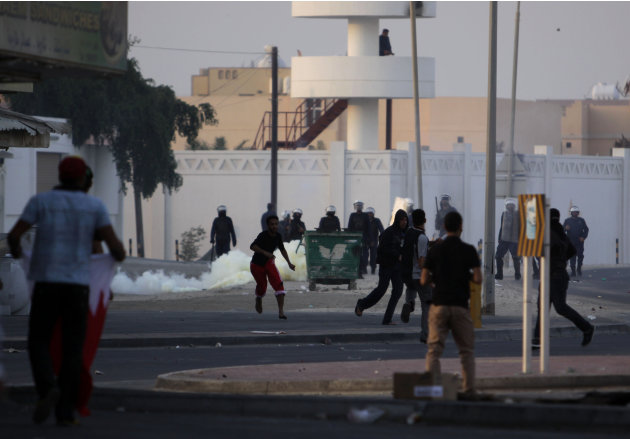
MANAMA, Bahrain (AP) — Riot police in Bahrain fired tear gas, rubber
bullets and stun grenades as they clashed Sunday with hundreds of
opposition supporters, some hurling Molotov cocktails, following the
politically charged funeral of a 15-year-old boy.

Thousands of opposition supporters carrying Bahraini flags and chanting
anti-government slogans converged on the island of Sitra, south of the
capital Manama, to mourn the death of Sayed Hashim Saeed. They are
demanding that police be tried for the deaths of some 40 people since
protests began in February.

Police earlier tried to seal off the site of the funeral to prevent crowds
from gathering.

The clash on Sitra marks the latest burst of violence in more than 10
months of confrontations and widespread street protests on the strategic
Gulf island nation, which is home to the U.S. Navy's 5th Fleet. The
country's Shiite-led opposition is pressing for greater rights and reforms
from the country's Sunni monarchy.

The opposition says the teenager died Saturday after a tear gas canister
fired at close range hit him in the chest.

Jaffer al-Sheik, 40, who identified himself as a relative of Saeed, said
after the funeral that the boy died while participating in a protest
march. He said the canister fired by riot police caused burns on Saeed's
chest arm and head.

The Interior Ministry has raised questions about the circumstances of
Saeed's death, saying that burns on the boy's body could not have come
from a tear gas canister. It has asked the public prosecutor to
investigate.

A statement signed by six opposition groups condemned Sunday's attack on
the funeral procession.

"We reaffirm our commitment to nonviolence," the statement said. "We call
on the government to stop its policy of repression... and bring to trial
those accused to respond to the legitimate demands of the Bahraini
people."

Also Sunday, Bahrain's new police chief announced that the kingdom would
hire an additional 500 police officers "from all sections of Bahrain
society," according to a statement from the country's Information Affairs
Authority. The official, Tariq Alhassan, said the extra officers would
work only in communities from where they were recruited.

Bahrain's Shiites have long complained of systematic discrimination that
largely keeps them out of state security forces and top government jobs.

The government has vowed to undertake reforms following the release of a
report in November that outlined human rights abuses carried out by the
government during this year's unrest.

Three Arrested at New Year's Eve Noise Demo/Dance Party in Bloomington, Indiana

Jan. 1, 2012 Anarchist News

This is a report back from the perspective of one participant in Saturday
night's demonstration:

Saturday night around fifty people gathered at the Occupy Bloomington camp
in People's Park for a roving dance party and noise demonstration outside
the Monroe County jail. The party left the park just before 11pm heading
west on Kirkwood Ave toward the square. The mood was festive as those
dancing in the street traded greetings of "Happy New Year!" with other
revelers on the sidewalks, in cars, and in windows overlooking the square.

Early on the dance party/march had the unwelcome escort by the BPD, though
the flashing lights did add to the celebratory atmosphere. It was the
first time the cops have shown any real interest in a march associated
with "Occupy Bloomington" since the camp was established nearly three
months ago. At this point they were mostly following the march and
blocking traffic along the route they assumed would be taken. Only a few
cars got aggressive towards the dancers, while most people were excited to
see such an unconventional method of bringing in the New Year. Our numbers
would occasionally swell as people on the sidewalks and in bars would run
out to join us for a minute before returning to their regularly scheduled
programs.

The march arrived at the jail at 11:30pm where more dancing ensued. At
this point three or four police cars were blocking the three-lane one-way
street, one or two cops were parked at the other end of the block, and a
couple more patrolled the area. Sparklers were lit and small fireworks
were ignited. One comrade read a statement through a megaphone expressing
solidarity with those people locked inside the jail and against this
prison society. It was inspiring to hear pounding on the windows from the
inside as we cheered from the outside. Just before midnight a banner that
read "Break Your Chains" was dropped from the Hilton hotel across the
street from the jail. Then at midnight huge 4th-of-July-like fireworks
shot into the sky. People continued to dance and cheer as the night sky
was lit up with thunderous booms and showers of light. It truly felt like
we were in control.

At maybe 12:30am the crowd danced up the street a few blocks towards the
newest hipster bar in town, pausing along the way to watch another huge
firework or four shoot up into the air. Tourists and revelers alike looked
on from the sidewalks and hotel windows, fucking iphones in position. Upon
arriving at the hipster bar, our numbers swelled to well over 100 and
maybe 150 as well-groomed partiers came out to dance and be seen in the
street. While the whole scene was being closely monitored by over a dozen
cops, it looked as if they were going to let the party ride out and fizzle
on its own accord. But that's not what happened.

Last call drew many back into the bar, and a much small crowd made its way
back north on College Ave. Somewhere in the mix a bottle was broken on the
sidewalk. Soon after that a pig-shaped pig jumped out of his car and
tackled a comrade on the edge of the larger group, punching him in the
head as he lay helplessly below the much larger cop. People initially
tried to pull our friend back to safety, but were unsuccessful. This lead
to verbal confrontations in the street between pigs and protestors. At
this point the crowd had dwindled and become more scattered. More cops,
including university cops, BPD, and Monroe County, showed up. The march
turned east on Kirkwood as fifteen cops or so followed on foot, ordering
people out of the street. By the end, two more comrades were arrested
during the confrontation. The crowd finally dispersed around 1:30am.

One comrade is being held on a misdemeanor with a $650 bond. Another
received a minor charge and got OR'd. The last person, however, is being
charged with 4 D felonies, including 3 battery on an officer. For some
reason his bond was set at $750, but was being held for 24 hours anyway.
We hope that by the end of today (Sunday) everyone will be out of jail.

This was not the first march since the dawn of "occupy bloomington," but
it was certainly the most confrontational and empowering. It will be
interesting to see the response from the city government, who so far have
taken a largely ambivalent stance towards the occupation. Last night's
demonstration was refreshing to see in a town run by self-congratulatory
and "enlightened" liberals of the Democratic Party and Indiana University,
who have grown comfortable with the docility of their constituents. This
resevoir isn't calm as it once was, and it's time to rock the boat.

Until every prisoner is free.

Political Prisoner Birthday Poster for January is now available!


Jan. 1, 2012 Anarchist News

Hello Friends and Comrades,

Here is the political prisoner birthday poster for January. As always,
please post this poster publicly and/or use it to start a card writing
night of your own.

Download at:

http://zinelibrary.info/files/pbooksheartoutlines.pdf

Things have been heating up in our neck of the woods and around the US.
Feel free to check our blog if you have the time.

Short and sweet this time around,

Until Every Cage Is Empty,

The Chapel Hill Prison Books Collective

Egypt defends storming of civil society groups


By AYA BATRAWY | Associated Press Jan. 1, 2012

CAIRO — A top Egyptian official responsible for overseeing civil
society groups on Sunday defended sweeps through the offices of 10 human
rights and pro-democracy organizations, rejecting denunciations from the
U.S., U.N. and Germany.

It was the first comment from the Egyptian government since the sweeps
Thursday that targeted, among others, U.S.-based groups invited to observe
Egypt's months-long election process.

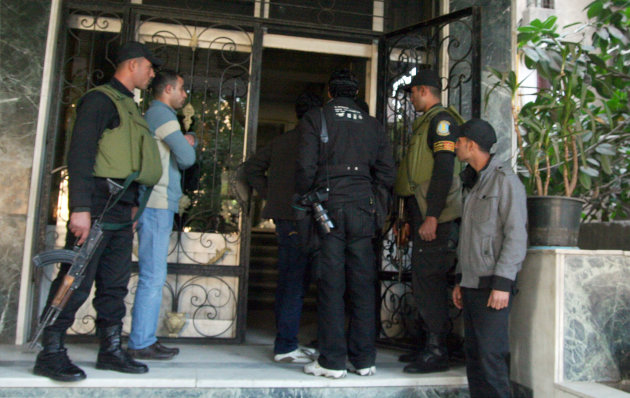
Reports of heavily armed police and soldiers storming into offices,
sealing the doors, rifling through files and confiscating computers set
off a wave of international protest against Egypt's rulers.

International Cooperation Minister Faiza Aboul Naga defended the operation
as a legitimate investigation into organizations suspected of operating
without permits and receiving "political funding" against the law.

Aboul Naga pointed to repeated complaints from the judiciary and the
ruling military about civil society groups acceptng foreign funds to
promote protests and instability and "influence public opinion in
non-peaceful ways." She said the order to investigate the groups came from
independent judges.

The military has pointed to "foreign hands" behind clashes with protesters
who are demanding that the military hand over power to civilians. More
than 100 people have been killed in the clashes since the military took
over in February.

Rights groups dismiss the charges as an attempt to taint the reform
movement that led to the ouster of longtime President Hosni Mubarak in a
popular uprising that demanded democracy and human rights.

The U.S.-based National Democratic Institute, International Republican
Institute and Freedom House all denounced the sweeps.

Aboul Naga, who was appointed by Mubarak and has survived numerous Cabinet
reshuffles since his ouster, refused to call the coordinated security
sweep a raid.

"This was not a raid or a storming or an attack. It was an investigation,"
she said. "There are foreign civil society groups that began operating
without permission, which is totally outside the law."

Under Mubarak, the government rarely licensed pro-democracy and rights
organizations, forcing them to work in a legal limbo. The situation has
not changed since Mubarak's fall.

The U.S. said it received assurances that the sweeps would end. Defense
Secretary Leon Panetta spoke by phone to the head of Egypt's ruling
military council, Field Marshal Hussein Tantawi, to emphasize the
importance the Obama administration places on the country's democratic
transition and appreciation for the decision to stop the raids.

The State Department said Friday that U.S. Ambassador Anne Patterson spoke
with members of the ruling military council and "received assurances that
the raids will cease and property will be returned immediately."

However, Justice Minister Adel Abdel-Hamid said Sunday that property and
bank statements would be returned only after a full investigation had been
completed. He did not say how long the investigations could take.

He also said the investigations would look into whether these groups are
behind the protests in Cairo's Tahrir Square, the focus of protests by
Egypt's reformers.

Aboul Naga said that the 17 offices belonging to the 10 organizations
investigated last week sprouted up across Egypt "behind the government's
back" only after the Jan. 25 uprising that led to Mubarak's toppling. The
International Cooperation minister also alleged that some of the
organizations under investigation have received 200 million dollars since
January, but she declined to name them or explain how the government
believes the money was spent.

The National Democratic Institute said it had been operating in Egypt
since 2005 "in an open and transparent manner, working to assist the
efforts of political parties and civic organizations." Freedom House said
it applied for permits three days before the sweep.

Also Sunday, the country's ruling generals announced that elections for
the 390-member upper house, a primarily advisory body, will conclude in
February rather than March. Voters will be electing 260 members, while the
remaining third will be appointed by the generals.