Monday, September 26, 2011

Nationwide condemnation of Irvine 11 convictions by student and activist groups

Immediately following the convictions of the Irvine 11 students last Friday, student and activism groups across the US have condemned the guilty verdicts while pledging to stand in solidarity with the Irvine 11, defend free speech and protect the right to dissent.

More than 30 Students for Justice in Palestine (SJP) university chapters nationwide signed onto a pledge over the weekend that stated, in full:

We join our voices with the unjustly charged and convicted Irvine 11, who dared to draw attention to Israel’s war crimes. Orange County District Attorney, Tony Rackauckus, has punished students who care about the world enough to try to change it. The 11 students refused to remain silent when Israeli Ambassador Michael Oren spoke at the University of California, Irvine in February 2010. Their brief outbursts, at best representing protected First Amendment speech and at worst harmless civil disobedience, have led to McCarthyistic misdemeanor charges. On September 23, 2011, an Orange Country jury found them “guilty.”

We unequivocally condemn these charges, which unfairly single out and criminalize Muslim students who chose to exercise their First Amendment right to speak out against Israel’s human rights abuses. Had the speaker not been Israeli, had the issue not been Palestine, had the students not been Muslim, these charges never would have been pursued. Rather, these charges reflect a climate of Islamophobia and an irrational exceptionalism for Israel when it comes to free speech. The charges chill the free exchange of ideas and students’ right to protest at universities nationwide.

It is our right and duty to speak out against Israel’s egregious violations of international law and Palestinian rights. The American government gives Israel over three billion dollars a year in military aid and is therefore directly responsible for Israel’s actions. We are troubled by the increased suppression of student voices in support of the Palestinian struggle for freedom. Student groups around the country continue to be targeted for their criticisms of Israeli governmental policies. University administrators find themselves under intense pressure from the Israel Lobby when pro-Palestine events occur on campus. It comes in the form of public smearing, alumni pressure, and frivolous lawsuits, as well as U.S. Department of Education investigations that seek to classify criticism of Israel as a violation of students’ civil rights. But it is the criminal prosecution of the Irvine 11 and the silencing of student activists everywhere that violate our civil rights.

It is inconceivable to suggest that Ambassador Oren, who has published four opinion-editorials in the New York Times alone and can easily command the attention of newspapers and television crews, has been denied a voice. On the other hand, it is routine for Palestinians to be silenced by the military and government that he represents without any media attention. The Irvine 11 shed light on the Palestinian voices constantly excluded from the media and public discourse.

To the Irvine 11: you are not alone. Like Dr. King wrote of his own unjust verdict, this week in September, the court convicted more than just you; it convicted every student dedicated to upholding human rights and ending injustice. We commend you for your courage and moral clarity. We know that the Irvine 11 are convicted criminals — but we are proud of their crime.

Harvard University’s Palestine Solidarity Committee posted a similar press release that stated:

The Irvine 11 should be commended for confronting Oren’s propaganda effort to whitewash Israel’s criminal actions and policies in front of college audiences. Instead, they have been unjustly punished for constitutionally-protected dissent that is a routine part of student activism, including here at Harvard.

On November 23, 2009, Harvard students also staged a walk-out of a speech by Oren at the Harvard Kennedy School. Last year, AIDS activists from Harvard and other colleges heckled and interrupted President Obama while he spoke in Boston. In neither case were students punished for exercising their right to protest.

… We call on students to support the Irvine 11 as they move ahead in appealing this unjust verdict. Further, we call on students to redouble their Palestine solidarity efforts. This attack only reinforces the urgency of continuing to organize in support of equality, justice and freedom for Palestinians and all oppressed peoples.

Meanwhile, interfaith organizations say they continue their committment to solidarity and support of the Irvine 11 and the right to free speech for everyone.

Jewish Voice for Peace posted its statement over the weekend, which read, in part:

This is a shameful day for the legal system and the Jewish communal leaders who actively supported this unfair railroading of young Muslim students and unprecedented attack on everyone’s right to free speech. How can it be that the Israeli ambassador enjoys more rights in the United States than do young Muslim citizens?

We hope this prompts some real soul searching among those who actively supported the case against the Irvine students simply because they didn’t like what the students had to say about Israel’s human rights record.

The principle of free expression for even unpopular speech, as it applies to all people, is fundamental to democracy. And it is never, ever OK to allow or support the unjust targeting of a minority group — which is what happened here. And frankly, as a religious and ethnic minority who was once a largely young immigrant population, Jews of all people should understand the need to protect minority rights.

And J. Jon Bruno, Bishop of the Episcopal Diocese of Los Angeles/Orange County, had this to say about the convictions and the need for interfaith solidarity:

Obviously in light of the Irvine 11 verdicts there is an immediate need for improved listening to one another across faith traditions and reaching a new place of mutual respect. Today I am calling upon fellow Orange County bishops, rabbis, and Islamic leaders to come together immediately in renewed solidarity to address the issues and injustices raised in relation to these verdicts. Our Episcopal congregations will also increase participation in the Shura Council’s Open Mosque Day on October 16 to demonstrate our understanding that Islam is at its core a religion of peace within our shared Abrahamic tradition, and deserving of equal protection under First Amendment freedoms.

For more on the Irvine 11 solidarity campaign, visit the Stand With the Eleven website at www.irvine11.com.

National SJP Statement on the Irvine 11

We Stand With the Irvine 11

“Ordinarily, a person leaving a courtroom with a conviction behind him would wear a
somber face. But I left with a smile. I knew that I was a convicted criminal, but
I was proud of my crime. It was the crime of joining my people in a nonviolent
protest against injustice.“
-Martin Luther King, Jr. (Case No. 7399, convicted of “violating the state (of
Alabama)’s anti-boycott law,” March 22, 1956, from Stride Toward Freedom: the
Montgomery Story.)
We join our voices with the unjustly charged and convicted Irvine 11, who dared to
draw attention to Israel’s war crimes. Orange County District Attorney, Tony
Rackauckus, has punished students who care about the world enough to try to change
it. The 11 students refused to remain silent when Israeli Ambassador Michael Oren
spoke at the University of California, Irvine in February 2010. Their brief
outbursts, at best representing protected First Amendment speech and at worst
harmless civil disobedience, have led to McCarthyistic misdemeanor charges. On
September 23, 2011, an Orange Country jury found them “guilty.”
We unequivocally condemn these charges, which unfairly single out and criminalize
Muslim students who chose to exercise their First Amendment right to speak out
against Israel’s human rights abuses. Had the speaker not been Israeli, had the
issue not been Palestine, had the students not been Muslim, these charges never
would have been pursued. Rather, these charges reflect a climate of Islamophobia and
an irrational exceptionalism for Israel when it comes to free speech. The charges
chill the free exchange of ideas and students’ right to protest at universities
nationwide.
It is our right and duty to speak out against Israel’s egregious violations of
international law and Palestinian rights. The American government gives Israel over
three billion dollars a year in military aid and is therefore directly responsible
for Israel’s actions. We are troubled by the increased suppression of student voices
in support of the Palestinian struggle for freedom. Student groups around the
country continue to be targeted for their criticisms of Israeli governmental
policies. University administrators find themselves under intense pressure from the
Israel Lobby when pro-Palestine events occur on campus. It comes in the form of
public smearing, alumni pressure, and frivolous lawsuits, as well as U.S. Department
of Education investigations that seek to classify criticism of Israel as a violation
of students’ civil rights. But it is the criminal prosecution of the Irvine 11 and
the silencing of student activists everywhere that violate our civil rights.
It is inconceivable to suggest that Ambassador Oren, who has published four
opinion-editorials in the New York Times alone and can easily command the attention
of newspapers and television crews, has been denied a voice. On the other hand, it
is routine for Palestinians to be silenced by the military and government that he
represents without any media attention. The Irvine 11 shed light on the Palestinian
voices constantly excluded from the media and public discourse.
To the Irvine 11: you are not alone. Like Dr. King wrote of his own unjust verdict,
this week in September, the court convicted more than just you; it convicted every
student dedicated to upholding human rights and ending injustice. We commend you for
your courage and moral clarity. We know that the Irvine 11 are convicted
criminals—but we are proud of their crime.
—-
“…Instead of stopping the movement, the opposition’s tactics had only served to give
it greater momentum, and to draw us closer together. What the opposition failed to
see was that our mutual sufferings had wrapped us all in a single garment of
destiny. What happened to one happened to all.”
-Martin Luther King, Jr.
Signatories (Add your group here)
National SJP Coordinating Committee
American University SJP
Arizona State University SJP
Benedictine University SJP
Boston University SJP
Brandeis SJP
Brandeis JVP
Brown University SJP
Cornell SJP
DePaul University SJP
Hunter College SJP
Illinois Institute of Technology SJP
Loyola University MESA
Northwestern University SJP
Ohio State University SJP
San Diego State University SJP
School of the Art Institute Chicago SJP
St. Xavier University SJP
Temple University SJP
University of California – Los Angeles SJP
University of California – San Diego SJP
University of Chicago SJP
University of New Mexico SJP
University of Pittsburgh SJP
University of Southern California SJP

--
Charlotte L. Kates charlotte.kates@gmail.co

Bolivian police break up anti-highway march

Sept. 25, 2011 Associated Press

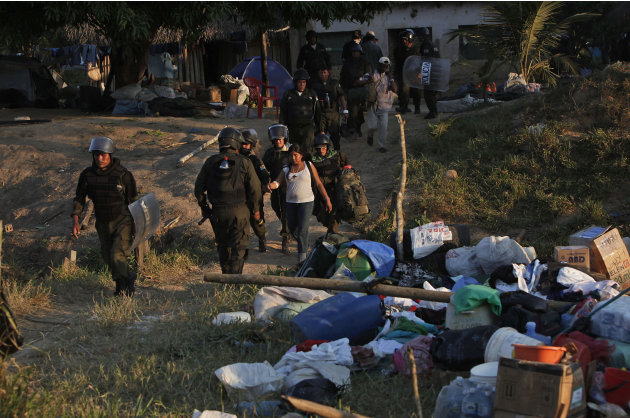
YUCUMO, Bolivia — Bolivian police used tear gas and truncheons to break up
a march Sunday by hundreds of indigenous activists protesting plans to
build a highway they say will despoil a vast Amazon nature preserve.

Police arrested the march's leaders, hauling them away in buses. Bolivia's
national ombudsman, Rolando Villena told Erbol radio "there was excess use
of force" by police in "violating the rights of the Indians in the
protest."

The U.N.'s representative in Bolivia, Yoriko Yasukawa, called on the
government to rely on dialogue.

Witnesses including an Associated Press photographer saw about 500 police
surround protesters, including woman and children, just before dusk Sunday
and set upon them with gas and clubs.

The government had no immediate statement on the crackdown but police
officers on the scene told the AP that there were injuries on both sides,
including police struck by rocks.

About 1,000 marchers opposed to the highway had departed the eastern
lowlands provincial capital of Trinidad in mid-August and were nearing La
Paz, the capital.

The police action came a day after protesters armed with bows and arrows
briefly detained Foreign Minister David Choquehuanca, forcing him to march
with them to protect them from police and from pro-government
demonstrators.

Interior Minister Sacha Llorenti accused the protesters of "kidnapping"
Choquehuanca.

President Evo Morales, this poor landlocked nation's first indigenous
president, has insisted the highway is necessary for development but on
Sunday said he would submit the highway's fate to a regional referendum.

Morales' stubborn backing of the highway has alienated many of the core
supporters who ensured his December 2009 landslide re-election by
insisting on the 190-mile (300-kilometer) Brazil-financed highway.

Environmentalists say the highway, which will connect Brazil with Pacific
ports in Chile and Peru, will mostly benefit Brazilian commercial
interests such as logging exporters while endangering a pristine,
600-square-mile (12,000-square-kilometer) nature preserve.

The Isiboro-Secure Indigenous Territory National Park is home to 15,000
natives, who live off hunting, fishing, gathering native fruits, and
subsistence farming.

The natives fear an influx of settlers will destroy rich natural
habitats,felling trees and polluting rivers.

The road is to be built with a $415 million loan from Brazil's national
development bank, and a Brazilian company, OAS, has the green light to
begin toppling trees.

Edwin Alvarado, spokesman for Bolivia's Environmental Defense League, or
LIDEMA, has called the highway a pretext for eventual oil exploration in
the rain forest.

Under a 2009 constitution championed by Morales, the country's indigenous
groups must be consulted in advance about any projects that might affect
their traditional lands.

The law does not give them veto power, however.

___

Associated Press writer Frank Bajak contributed to this report from Lima,
Peru.

Voices from Solitary: The “Life Negating Emptiness” of the Pelican Bay SHU

September 25, 2011 Solitary watch
by Jean Casella and James Ridgeway

In 2008 Hector Gallegos won second prize in the essay category in PEN American Center’s Prison Writing Contest with his powerful account of life in the Security Housing Unit (SHU) of California’s Pelican Bay State Prison. What follows is a long excerpt from his essay, entitled “Species of a Lesser God”; the full piece can be read on PEN’s website.

Indelibly etched in the canyons of memory I can remember being herded onto the Grey Gooses as these prison transportation buses are commonly referred to throughout the California Penal System. The solemn procession of prisoners wore a somber ghostly mask; one by one waist-chained, handcuffed and shackled we stepped into the belly of the Grey Goose. I cannot quite describe with any degree of accuracy, the feeling that settled over me prior to boarding, but there was an ominous silence which hung thickly in the air like a heavy dark cloud forecasting a wickedly vicious storm. It projected the coming of a tempest that would progressively descend upon my life like a savage moving monsoon. Indeed, a psychological-emotional storm we would all come to knew in the life negating emptiness that awaited our arrival in the Security Housing Units (SHU) of Pelican Bay State Prison…

The heat inside the bus was as stifling as the tension which lingered in the surrounding atmosphere. As the bus roared angrily down Highway 101 the trance inducing drone of the big diesel engine lulled me into reflections of my life. Memories that had soared past me like the scenery flying by outside the barred, tinted windows of the anonymous Grey Groose and as swiftly as the life I had led thus far.

The restless dismal chimes of shackles and chains broke me away from the melancholy spell I had fallen under, and there followed the sudden realization that the world of oceans, mountains and landscapes would all soon be but a memory of another lifetime. Looking around me I found not to be alone in this realization, for the other prisoners there seemed to be entertaining similar thoughts, but no one dare speak of them.

What awaited us at the Pelican Bay SHU with its eerily silent corridors was a purgatory of sorts, a vacuum of uncertainty, sealed off from every thing and every one. A place where one is virtually entombed in a concrete vault with scarred and pitted walls depicting the idleness, boredom and, in some cases, the lunacy of a previous occupant. It’s a world of its own where, for most, refuge can only be found through a dreamless state of slumber.

There is a look in the SHU prisoner’s eyes that is haunting. A foreboding look from eyes that have themselves stared into the eyes of madness and human cruelty. Eyes that have looked far into the abyss of emptiness. Eyes belonging to a species of a lesser God.

This is where my writings began. Borne of a burning need to find meaning during one of the darkest periods in my life. That this took place within the confines of the most depraved, isolated and suffocating prison units in California, did much to determine my present view of the world, perception of self and that of the human condition as a whole. It was a period in time which would ultimately lead me through the loneliest corridors of my soul, across the coldest expanses of relived personal tragedy and finally back to the fulcrum in which this paradox is precariously balanced.

It is within this balance between the suffering of existence and the reality of living where I found a powerful hidden truth that gave way to a deeper meaning to life. I say this with a deep rooted conviction because I have come face to face with what has been said are among man’s greatest fears; the fear of death, fear of the dark and fear of being alone. Before I continue, however, I wish to briefly define what is meant by this writer in having faced the fears mentioned above, so that the intended meaning is not lost on the reader. It further provides a basis from where the imagination is better able to perceive the underlying message which yearns so strongly and with such passion to express itself. It’s an account that not only wants, but needs to be told.

In any case, when I speak of having faced the fear of death, I do not mean DEATH as in the clinical sense of the word, but rather of two aspects of the one thing; both of which are essential to the phenomenon of death. One being symbolic of death as in the “then and there” physical presence, and the other of a physic-psychological color. The prisoner who has given it some thought, in particular the ones confined in extremely isolated conditions such as those found in the Security Housing Units (SHUs) of Pelican Bay State Prison, soon finds himself faced with a terribly frightening reality. That, with the exception of a few loving family members, or maybe a dear friend, he no longer exists to the outside world. The only thing that remains of him out there are memories, and the love for him vigilantly kept in the sanctity of the hearts and minds of his family. As such, in a world beyond prison walls, one is nothing more than a ghost of his former self. The point is nailed home when one realizes how much of his life has passed him by while he sits in the same cell, year after year. He longs for what is passing him by, knowing he can never be a part of it. It is as if he has died and observes this from a reality, which indeed perhaps only the dead would understand.

Another aspect of the symbolism of death experienced by a prisoner is when he discerns, by the mere fact of his incarceration he has killed the “Him” that should have been, the lover he wishes to be, the father he cannot be, the son he failed to be and the person he never grew into. He has, in essence, killed, at least for the duration of his confinement, that greater part of himself. In this sense and for the time being he may well be dead, for he cannot live up to the expectations of what he should have been. The prisoner lives on the dark side of the moon. He is tormented by two worlds, the one he lives in and the one he left behind; caught in sticky quagmire somewhere between heaven and Hell.

In regard to the physic-psychological aspect of death. What is meant here is the collective summation of the effects isolation has on a person subjected to a prolonged period of sensory deprivation. Here a prisoner is no longer able to experience what is inherent in human life—the touch of another human being! I speak of a place where one is stripped of not only his freedom but of his association with other human beings and of his personal sense of purpose and awareness. Where common compassion, pity and human decency are virtually unheard of. And when man is deprived of the qualities which make him human, for a lengthy amount of time, he is gradually and unwittingly transformed into a creature of sorts and will respond in kind. Then there are those who will give way to perhaps the saddest, cruelest death a man can suffer; “death of the mind and will to resist”. An individual’s sense of self worth is quietly and maliciously gnawed away at by monotony and emptiness. Death by attrition slow, sure, and maddeningly relentless.

I can describe what I just have with such clarity because I gave witness to it in the catacombs of Pelican Bay. And like any experience that cannot be wholly understood by mere observation; “I lived it!” I, like the countless others whose misfortune it was, and continues to be in the SHU, know how cold and terrifying it is to be in the suffocating grip of oblivion. An oblivion I came to terms with only because I was bullied into it by a brutal reality. But what’s unsettling about this acceptance is the realization that within this oblivion my thoughts alone confined my existence. For in the face of such emptiness I had nothing by which to measure it. Questions such as, “Why do I continue to forge on?” would pound away at me. “For what purpose?” And most of all, “Who or what have I become?” It was then when I was cast under the unbearable light of conscious being. I was forced into it. The isolation in the SHU demanded that I ponder my situation, otherwise I would have surely drowned in its paralyzing numbness, living out a slow death. Even as I write this account, I wonder if my writings are not merely the ravings of a mad man, perhaps I am already submerged in the numbness.

To question one’s own sanity and existence is a disquieting discourse, because when the questions are posed, initially there are no viable answers. One shouts out these questions in the seemingly empty canyons of thought, only to be reciprocated with haunting echoes of the same questions. To realize this is to recognize the pressing need for meaning in one’s life. Here in prison one must travel through the crucibles of self-examination and through all of its fires to arrive at the answers. In doing this one must first learn to confront his fears, whether they be death, darkness or loneliness, before he is able to move on in search of his own life’s meaning. It is here in this gulag of concrete, steel and misery where I came to learn the subtle difference between existing and living. This self discovery came by way of learning what it feels like spending countless hours in the icy grip of loneliness. Through this experience I am able to understand why so many people are so utterly afraid of being alone—a piece of knowledge attached to the price of bitterness.

My personal experience is not just a poignant account of human misery in solitary confinement, but also of a collective experience of what prison life entails. I believe it gives the reader a penetrating insight into the human condition as a whole. It’s through my personal writings that I seek to reach out. Not only for myself but for those others whom are still struggling to find a rational context for it all…

Mass grave found in Libya with remains of 1,270

Sept. 25, 2011 Associated Press

TRIPOLI, Libya — Libyan revolutionary authorities say they have discovered a mass grave containing the remains of 1,270 inmates killed by the regime of Moammar Gadhafi in a 1996 prison massacre.

The site was found near Tripoli's Abu Salim prison, where the victims were killed on June 26, 1996, after protesting conditions at the facility.

The announcement was made Sunday by Dr. Ibrahim Abu Sahima of the government committee overseeing the search for victims of the former regime.

He says investigators found the grave two weeks ago after getting information from captured regime officials and witnesses.

Officials will ask for international assistance in identifying the remains.

Hunger Strike For Vegan Prisoner Reinstated; Please Call

Sept. 23, 2011 Infoshop News

Manuel Salas has reinstated his hunger strike as the Waupun prison has
apparently been refusing to honor vegan food requests for another inmate.
Please call Waupun Correctional Institution Warden William Pollard at
(920) 324-5571 and tell him as a friend of Manuel Salas #504212, you are
aware of his hunger strike and that you are making sure that requests for
vegan food be honored as required, as it is a legal right.

About Manuel

My name is Manuel C. Salas; I was born in Virginia but later moved to
Wisconsin and lived in Texas. I’m a 25-year-old vegan polticized prisoner
and animal rights activist. A few months before my 19th birthday I was
arrested for arson (unrelated to my animal rights activism). I was given
12 years, 6 in/6 out, but I got my time pushed back for a number of
reasons. I was facing 2 “baiter” cases out of a prisoner protest but they
later got dropped due to the fact I took a plea deal for the other
protests I kicked off for vegan food. I get sentenced in October 2011 but
I do not know how much time I’m going to get for that.

I became interested in animal rights when I was about 15. I became
vegetarian off and on from about age 16. At 15 I started volunteering at
shelters for battered and abused animals and also worked with some groups
that rescue and rehabilitate injured animals. I also began attending fur
protests and anti-hunting protests. At about 18 I became vegan.

I have been locked up in Wisconsin since 2005, moved to Wisconsin Prison
in 2006 and have been locked up since. I have been fighting for vegan food
and animal rights any way I can. The vegan food is not nutritionally
adequate and I protested the food asking for better quality meals and was
instead moved to Waupun Correctional Institution which did not provide
vegan meals. I then went on a hunger strike to gain access to vegan meals
and won. I’m now working again to improve the quality of the vegan meals
in prison.

In addition to animal rights work I’m also working to raise awareness
around HIV/AIDS and to improve the level of care for those who have AIDS
and are imprisoned. I do not have HIV/AIDS but my brother is HIV positive
and in Wisconsin Prison where he faces harrasment and inadequate health
care. Because of it I try and help when I can.

Saturday, September 24, 2011

Letter from a prisoner in Pelican Bay SHU

[Note: Letter typed in full. All ellipses were in the
original. Only changes made were correction of clear misspellings.]


Letter from a prisoner in Pelican Bay SHU
(postmarked June 13, 2011)

Hello, my name is [withheld]. I live in Pelican Bay SHU and was
recently denied for my inactive review for a single source which was
my name and number in someone else's address book...

This entire review process is a complete sham, the only way for me to
be able to see the mainline is to become an informant.

The active/inactive process is truly a house of cards and I honestly
believe the courts fully understand this, which is why they honestly
fear intervening because the validation program would crumble...

So these words are written with a clear and focused mind on the task
ahead. There's been months of soul searching, real personal tug of
wars but ultimately it's brought about my decision to hunger strike.

With a tear in my eye I can/do look back over my life and fully
realizing the tremendous amount of pain and damage I've caused my
family and friends as a youth.

My story was a violence fueled path of sheer destruction and for all
of those I hurt, I do take full ownership of...

If turning back the hands of Ole Father Time was a reality I'd be in
line to heal those who were hurt...

Though standing before you today is no boy but rather a 37 year old
man who believes with his maturity came truth of/in himself which
ultimately led to his integrity and honor as a man.

Whereas I've been in Ad/Seg and SHU for merely 8 years, all around I
can clearly see my future in cells aside and below me, 10 years, 16
years, 22 years...

In the quietness of my mind I am struck by the immense task of
adjusting my mind and body to these extreme isolation realities
decade after decade without going insane...

It's not too promising when year after year all I see is the effect
of these extreme conditions of deprivation crushing once prideful and
courageous men into shells of their former selves...

I do pray to the gods above that they allow my spirit and soul to
burn bright and to endure.

So the past, present, and future. Our litigations they have
failed. The state and federal courts are unwilling to call this
prolonged isolation and legalized psychological torture, just that, torture!

Because when a man walks into that debriefing room he's been totally
broken, broken to the point of saying anything for one sole purpose
to stop the pain and if that's not a confession under extreme
pressure and torture then I don't know what is...

Every avenue has been taken to get out of here with my pride,
dignity, and honor in hand. I've tried the institution appeals, a
total joke and as I stated earlier the courts refuse to make any
substantive changes and without that CDC will continue to justify
keeping me and the rest in these extreme conditions of isolation for
the mere fact that we are labelled as gang members and simply refuse
to become informants and debrief...

So in with the realization of the fact that the courts will allow
me/us to die here there's been long thought as to how to peacefully
resist this prolonged psychological torture. The collective
conclusion is that the only means left available to us is to go on a
serious hunger strike.

I volunteered to give all that I have for myself, my family and those
who know and respect me.

I in no way, shape or form am I suicidal nor do I wish to harm myself
in anyway. But the facts are that CDC has drawn a hard line in the
sand and the only way from underneath these conditions are to debrief
or die. I wish to do neither.
I can't articulate exactly how badly I want to hug my mother or speak
to my father over the phone or send them a yearly photo of their
son. But it's huge!

Instead I am limited to maintaining my relationships with family
through the mail and IGI has always viewed I/M [inmate] mail as a key
component in the debriefing policy in where they are able to put
pressure on relationships in the hopes of breaking them up and
further isolating us with the hope we choose to debrief.

I choose to stand defiant, I stand tall and always silent and I
exercise my option to fully protest via hunger strike.
I will not become just another broken faceless soul forced to become
a confidential informant for CDC to relieve this burden only to
burden someone else...

I hunger strike with the hope of gaining some form of relief so the
next load of men, young and old, won't have to be broken down, drove
insane or killed to find relief...

I must end with a word for my beautiful family. I love them all and
have learned many valuable lessons of respect, understanding, duty,
and integrity by their stellar examples. They truly are my rock in
dark times and I love them all.

Respectfully written,
[name withheld]

Damages for my unjust 'terror' arrest

A book available in the library called 'Al-Qaeda Training Manual' led to a
student being arrested and incarcerated.

Sept. 21, 2011 by Rizwaan Sabir Al Jazeera

Over three years ago, when I was a Masters student at the University of
Nottingham, I did not imagine I would be writing an article for Al
Jazeera. Let alone one in which I would be explaining to its readers that
I had been successful in holding the police to account, for falsely
imprisoning me in solitary confinement for seven days as a suspected
terrorist.

Only weeks before the trial was to begin, the police - desperate to
prevent embarrassment and criticism - settled the case out of court. They
paid me £20,000 ($31,000) in compensation, all of my legal expenses and
removed all the incorrect (and unnecessary) information that they held on
my intelligence file. Documentation that stated I was a “convicted”
terrorist, that I wore a black hoody with the words "Free Palestine"
written on it and had an "attitude" toward the police. The police also
issued an apology for a stop and search that I was unlawfully subjected to
under the Terrorism Act 2000 and accepted that I was not a terrorist.

If you’re not familiar with what happened on May 14, 2008, you can be
forgiven for thinking that I must have done something very serious. Why
else would I be arrested in a joint police operation on suspicion of being
involved in the ‘commission, preparation or instigation of acts of
terrorism’, held in solitary confinement for seven days and subjected to
daily interrogation and questioning? The truth, however, is quite the
opposite.

I was arrested (with a friend of mine, Hicham Yezza) for being in
possession of a declassified, open-source document that I had downloaded
from the US Department of Justice website to assist my upcoming PhD
research on Islamic terrorism. The document (given the title ‘Al-Qaeda
Training Manual’ by the US government to convince a jury that the people
arrested for the East Africa bombings were terrorists) is such a dangerous
document that it can be loaned through the University of Nottingham’s own
library system or purchased, even by children, in a glossy blue-cover from
high-street bookshops such as Blackwells, Waterstones and WH Smiths (who
have recently pulled it from their website).

The hysteria surrounding ‘campus radicalisation’ came to fruition when
this library book and two related academic journal articles were
discovered on my friends computer, who had kindly offered to help me with
my research proposal. The ‘dangerous’ material was reported to the
Registrar of the University of Nottingham, who, without any due-diligence
or regard for university statutes and governmental guidance, instructed
the Deputy Head of Security to call the anti-terror police. The police,
not being able to take a chance where matters of library books were
concerned stormed onto campus and arrested me and my friend as suspected
‘terrorists’.

Held for 7 days in solitary confinement, we (and our family and friends)
had our lives turned upside down. On my release without charge, I
immediately knew that the legal avenue was the only way that I could clear
the label of “terrorist” that had been attached to my name.

I instructed lawyers to bring proceedings against the police for false
imprisonment and racial discrimination, and 3 years later, I can say that
the struggle against the police has ended with a victory that will show
the world that holding the police to account can be achieved. It is hard
work, exhausting and stressful, but nevertheless possible.

The police, as expected, have been spinning their loss to the press by
claiming that they have not accepted liability for my wrongful arrest and
false imprisonment. To me, and I’m sure to the public, it is abundantly
clear that if the police were innocent, they would have gone to trial and
fought their corner, not paid compensation and all of my legal fees. To
me, and I’m sure others, this is a sign of guilt.

The story does not end here though. The University of Nottingham’s spin
doctors have been busy claiming that my legal victory is a matter between
me and the police, but, as they know, it has everything to do with them.

Dr Rod Thornton’s paper - "How a student’s use of a library book became a
‘Major Islamist Plot" - forensically documents how the university
participated in a campaign of sabotage and discrimination not only against
me (even though I had been released without charge and cleared) but
against those who dared to stand with me. For example, I was recently told
by a senior civil servant at the Department for Universities (DBIS) that
the University's Registrar attempted to - via a breifing - misinform the
department regarding my arrest. Internal governmental documents that were
used by Dr Thornton in his whistle-blowing paper corroborate such a claim.
When Dr Thornton spoke up against what had happened and tried to hold the
university to account, he was subjected to disciplinary procedures and
eventually suspended by the Vice-Chancellor. He remains suspended at the
time of writing.

The allegations he makes are so serious, that only an independent, judge
led public inquiry can bring closure to this sorry saga. The university,
in its conduct over the last three years has shown that it is not capable
of impartially bringing closure to the issues Dr Thornton raises, and
because there is no public body in the whole of the United Kingdom that
has the remit (or desire) to hold the University of Nottingham to account,
only a judge led public inquiry can bring closure to this affair. Once a
public inquiry has taken place, and Dr Thornton has been reinstated, will
my name be fully vindicated.

Let my victory against the police be a clear message to the University of
Nottingham that I am here to stay and will hold them to account for their
actions.

Rizwaan Sabir is a PhD student at the University of Strathclyde where he
is researching UK and Scottish counter-terrorism policy since 9/11.

You can follow him on twitter @RizwaanSabir

The views expressed in this article are the author's own and do not
necessarily represent Al Jazeera's editorial policy.

Are We Troy Davis? - An Ⓐnonymous Message

Farmers in China’s South Riot Over Seizure of Land

By ANDREW JACOBS The New York Times
September 23, 2011

BEIJING — Rioters in the southern Chinese province of Guangdong have
besieged government buildings, attacked police officers and overturned
SWAT team vehicles during protests this week against the seizure of
farmland, said officials in Shanwei, a city that skirts the South China
Sea not far from Hong Kong.

Lufeng residents have long engaged in a battle over land.

According to a government Web site, hundreds of people on Wednesday
blocked an important highway while others mobbed the local headquarters of
the Communist Party and a police station in the city of Lufeng, injuring a
dozen officers. Some witnesses, posting anonymous accounts online, put the
number of rioters at more than 1,000.

The protests continued Friday, with farmers gathered in front of a
government building banging gongs and holding aloft signs that said “Give
us back our farmland” and “Let us continue farming,” Reuters reported.

The authorities say the violence escalated Thursday after rumors spread
that the police had killed a girl. At least four people were arrested,
including a man officials accused of instigating the crowd.

The violence was the latest outbreak of civil unrest in China fueled by
popular discontent over industrial pollution, police misconduct or illegal
land grabs that leave peasants with little or no compensation. Such “mass
incidents,” as the government calls them, have been steadily increasing in
recent years, providing party leaders with worrisome proof that official
malfeasance combined with a dysfunctional judiciary often has combustible
results.

Last week, hundreds of residents protesting environmental contamination by
a solar panel factory in Zhejiang Province stormed the factory and
destroyed office equipment and vehicles. Weeks earlier, 12,000 people
peacefully gathered in the city of Dalian to demand the closure of a
chemical factory.

In Lufeng, the protests were just the most dramatic manifestation of a
long-running battle over land that residents say their ancestors reclaimed
from the sea. According to a local Web site, the Lufeng city government
has already sold off more than 800 acres of the property for industrial
parks and high-priced housing. The proffered compensation per acre,
villagers said, has been barely enough to buy a new bed.

“Wake up, my neighbors, if we don’t unite now, the land of our ancestors
will be sold off to the last square meter! If we don’t unite now, our
children will be homeless!” read one posting on the site.

“We will have no where to bury our parents or raise our children!”

Municipal governments, which own all land in China, largely depend on
sales of long-term property leases to fill their operating budgets. In
many cases, private real estate companies collude with officials to clear
and develop the land as quickly as possible.

The latest seized plots were sold to a developer for about $156 million,
according to The South China Morning Post, which first reported the sale
and seizure. According to the company’s Web site, the complex is to be
called “Country Garden” after the name of the developer.

“To shape a prosperous future through our conscience and social
responsibility,” is one of the company’s mottoes.

News of the demonstrations and photos and videos were quickly deleted from
the Web by censors, but a few images persisted Friday. In one,
demonstrators carried a banner that read “Give back my ancestors’
farmland.” A video lingered on overturned police vehicles, including one
with graffiti that read “running dogs,” an insult once directed at
perceived enemies of the people.

The continuing unrest could pose a threat to the political aspirations of
Wang Yang, the provincial party secretary who has partly staked his
reputation on promoting the well-being of Guangdong’s 104 million
residents and by trying to gauge the level of their happiness.

“Happiness for the people is like flowers,” Mr. Wang wrote this year. “The
party and the government shall create the proper environment for the
flowers to grow.”

The province is China’s most populous and a manufacturing powerhouse that
produces roughly one third of the country’s exports.

Mia Li contributed research.